
By Grace Adcox
Across the country, the promise of stable, affordable housing is becoming increasingly out of reach — not just for the most vulnerable, but for a growing share of Americans. Rising costs, stagnant wages, and mounting utility bills are forcing millions to make difficult trade-offs just to stay securely housed. These issues are compounded by the pressures that climate change and increasingly extreme weather place on infrastructure, including housing, and emphasize the importance of understanding how national adults think about housing affordability, climate resilience, and potential solutions.
To better understand this, Data for Progress conducted a recent national survey asking adults about their experiences with key housing challenges and their perspectives on a range of green housing-related policy proposals. The findings reveal both the widespread nature of housing insecurity and a strong appetite for targeted interventions that expand access to affordable, energy-efficient homes, while protecting tenants and workers alike.
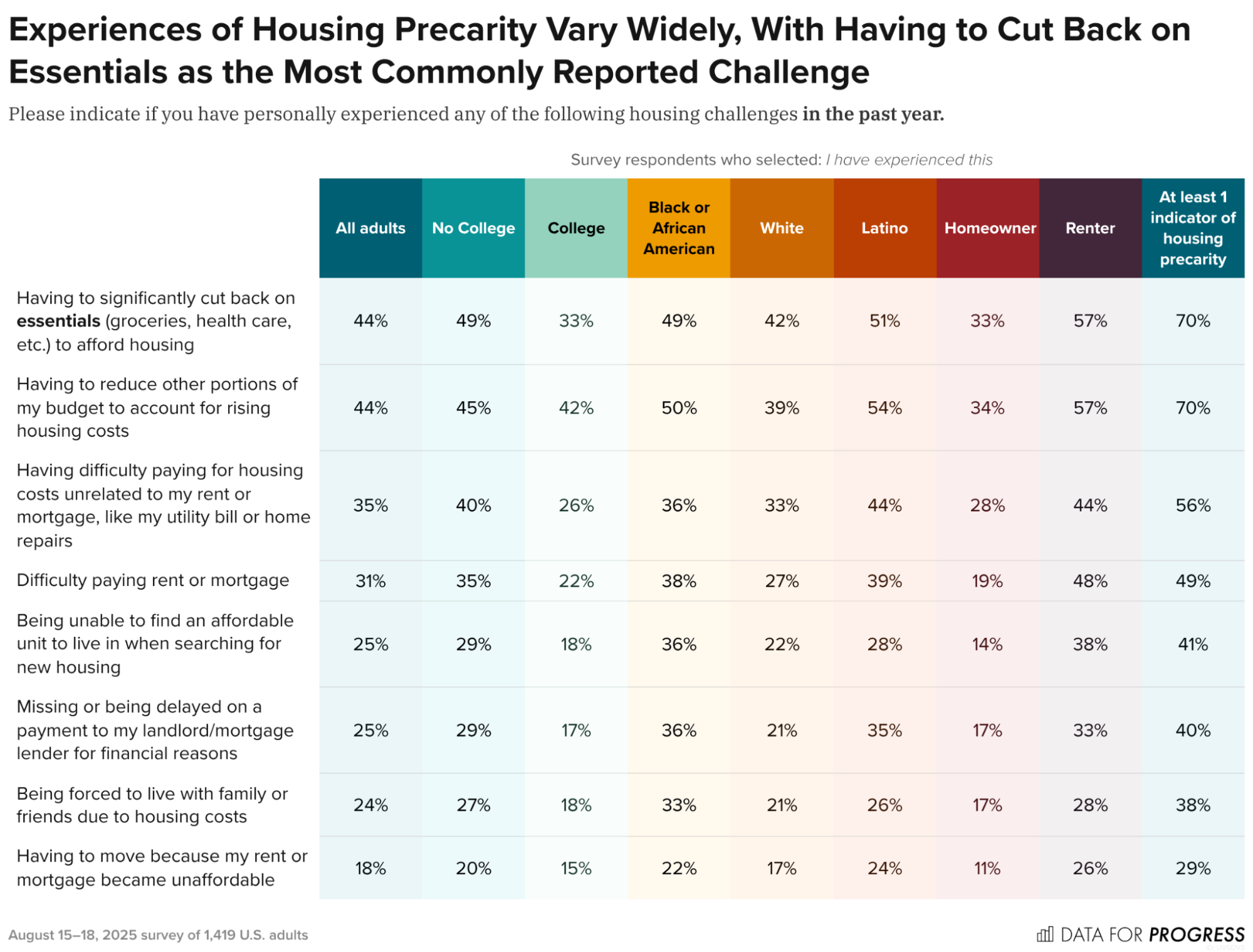
National responses indicate that housing precarity is felt widely, with more than 3 in 5 adults (63%) reporting that they have experienced at least one indicator of housing precarity in the last year, such as difficulty paying their rent or mortgage, or needing to cut back on essentials to afford housing. Experience with at least one indicator of housing precarity is more widely reported among adults who are renters (77%), under age 45 (72%), Black (71%), and Latino (71%), relative to other demographic groups. More women also report experiencing at least one indicator of housing precarity than men (66% vs. 59%).
Americans' most commonly reported housing challenges are having to significantly cut back on essentials and having to reduce other portions of their budget to account for housing costs.
In the past year, adults report experiencing the following housing-related challenges:
Having to significantly cut back on essentials to afford housing (44%)
Having to reduce other portions of their budget to account for housing costs (44%)
Having difficulty paying for other housing-related costs, like their utility bill or home repairs (35%)
Difficulty paying their rent or mortgage (31%)
Missing or being delayed on a payment to their landlord or lender (25%)
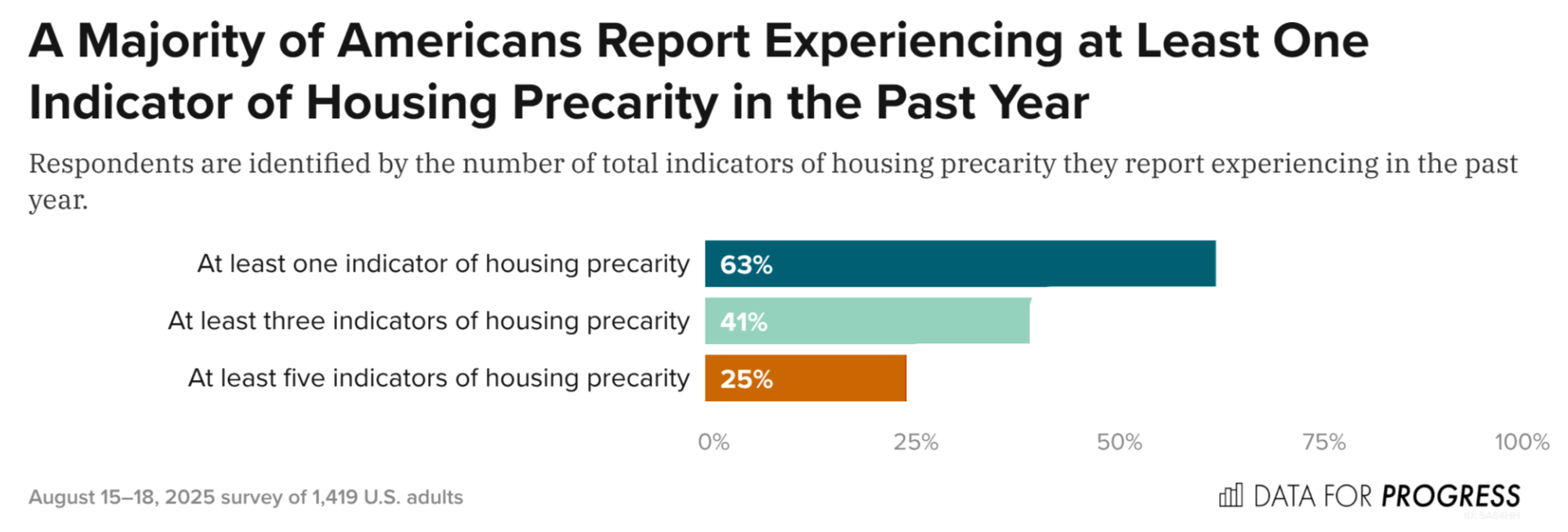
More than 2 in 5 adults (41%) report experiencing three or more indicators of housing precarity in the past year, while 1 in 4 adults report experiencing five or more indicators in that span. While a majority of respondents have experienced at least one measure of housing precarity in the last year, these findings show that housing precarity is felt more acutely by smaller minorities of adults who are facing multiple compounding challenges related to securing and affording their housing.
After being provided with a list of potential policy priorities for the federal government, an outright majority of Americans say that a top priority should be delivering more affordable health care (60%), followed by delivering quality education (54%) and new, well-paying jobs (53%). Delivering new clean energy (35%) and more affordable green housing (29%) are considered top priorities by a smaller percentage of respondents overall. Notably, delivering affordable green housing is a higher priority for Black (48%) and Latino adults (36%), and people who have experienced at least one indicator of housing precarity (33%).
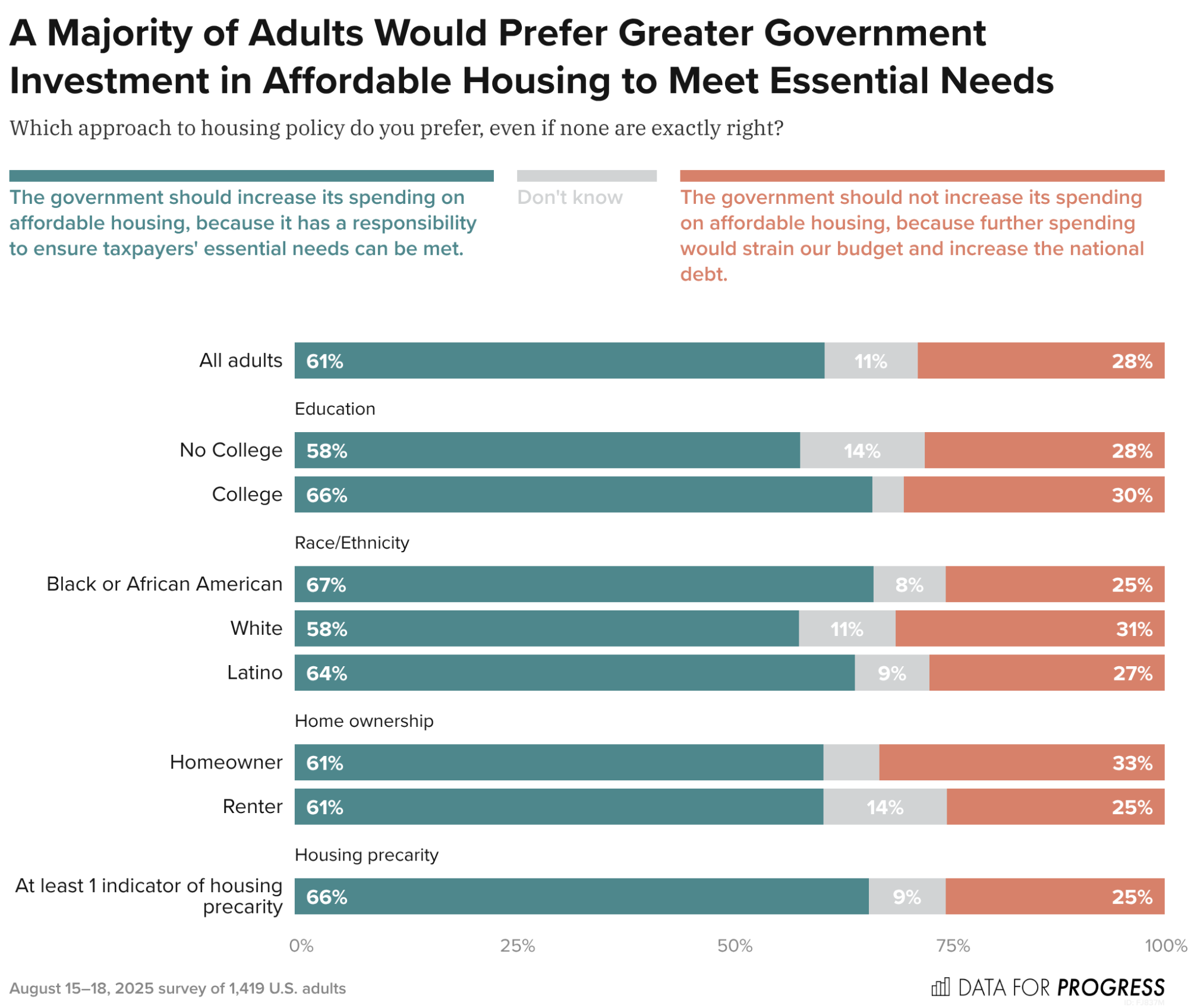
A majority of respondents are supportive of the federal government increasing its spending on affordable housing by a +33-point margin. A strong majority (61%) agree with a statement saying “the government should increase spending on affordable housing because it has a responsibility to ensure taxpayers’ essential needs can be met,” while 28% agree with a statement saying the government should not increase spending because it would cause budget strain and national debt concerns. Among individuals experiencing at least one measure of housing precarity, agreement that the government should increase spending on affordable housing rises to 66%.
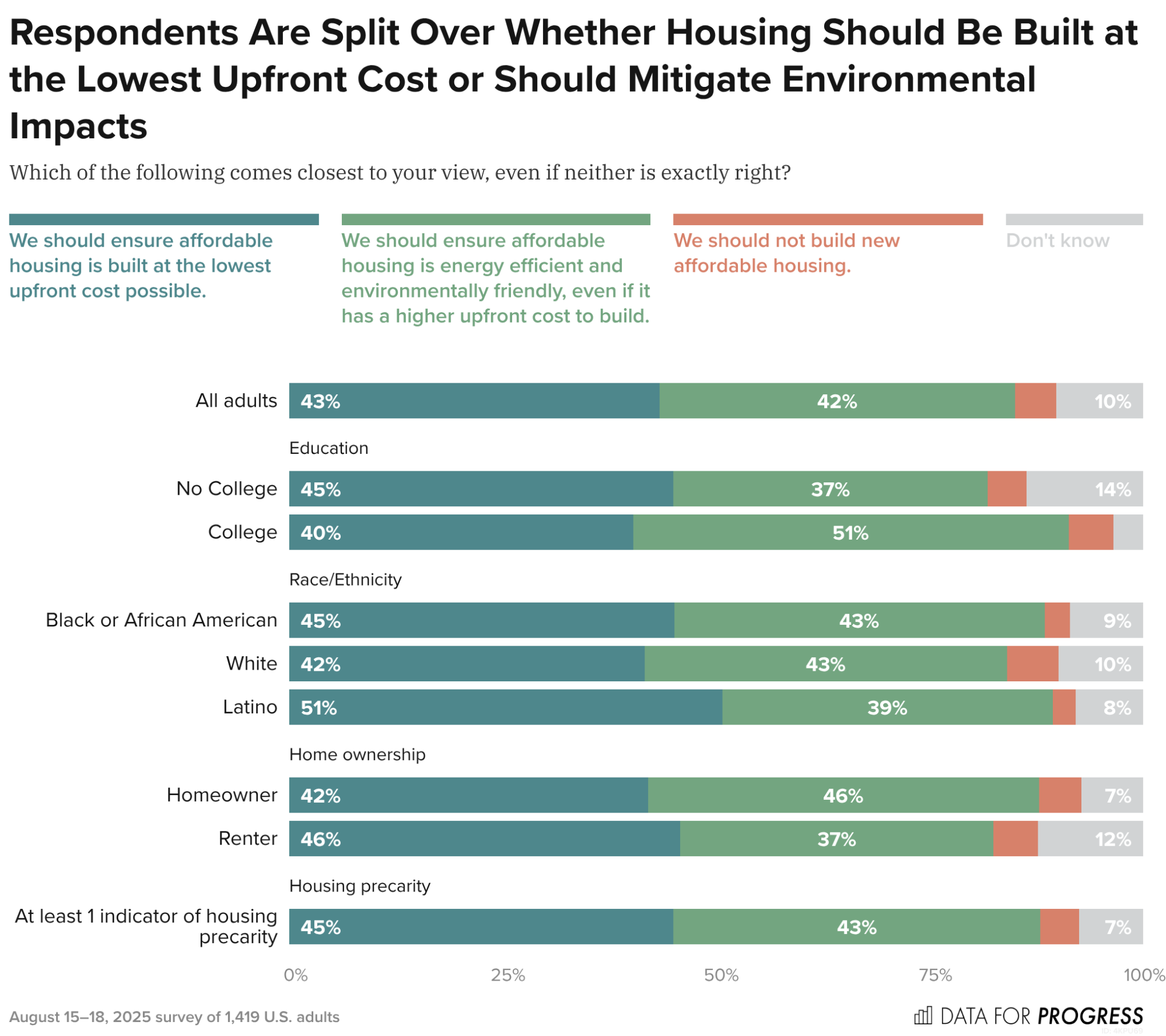
When asked to choose between three statements about whether and how affordable housing should be built, 43% of adults believe affordable housing should be built at the lowest upfront cost possible. This is almost equivalent to the proportion of adults (42%) who think it should be built to be energy-efficient and environmentally friendly, even if it has a higher upfront cost. Even among respondents who report experiencing at least one indicator of housing precarity in the last year, views are split: 45% think housing should be built at the lowest upfront cost, while 43% think it should be built with energy efficiency and environmental impacts in mind, even if it is more costly upfront.
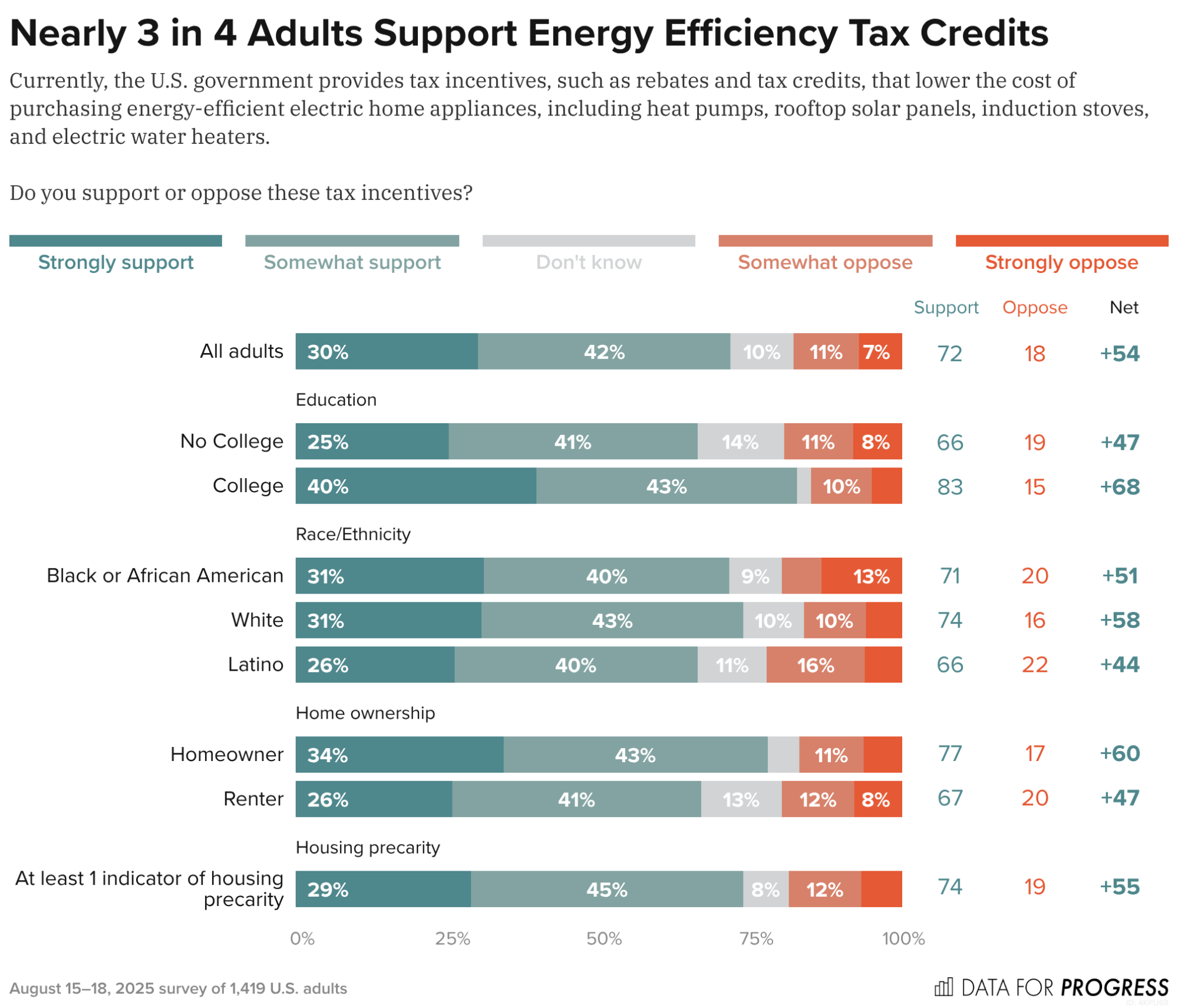
Additionally, Americans are widely in favor of policies that lower the cost of energy efficiency upgrades for housing: 72% support tax incentives for energy-efficient electric home appliances, including majorities across all demographic groups tested.
The survey also shows that U.S. adults are strong proponents of many policies related to affordable green housing development and requirements for affordable housing developers to protect tenants and workers. More than three-quarters of adults (77%) support requiring competitive wages and safety standards for affordable housing developers, followed by 74% who support investing in energy efficiency and electrification upgrades for low- and moderate-income households. There is also substantial support for providing low-interest loans to construct new affordable housing with high sustainability standards (72%), providing financial support for retrofitting existing properties for energy efficiency (72%), requiring developers to limit rent and price hikes after green building improvements (72%), and creating apprenticeship programs to encourage diverse hiring in the construction trades (71%).
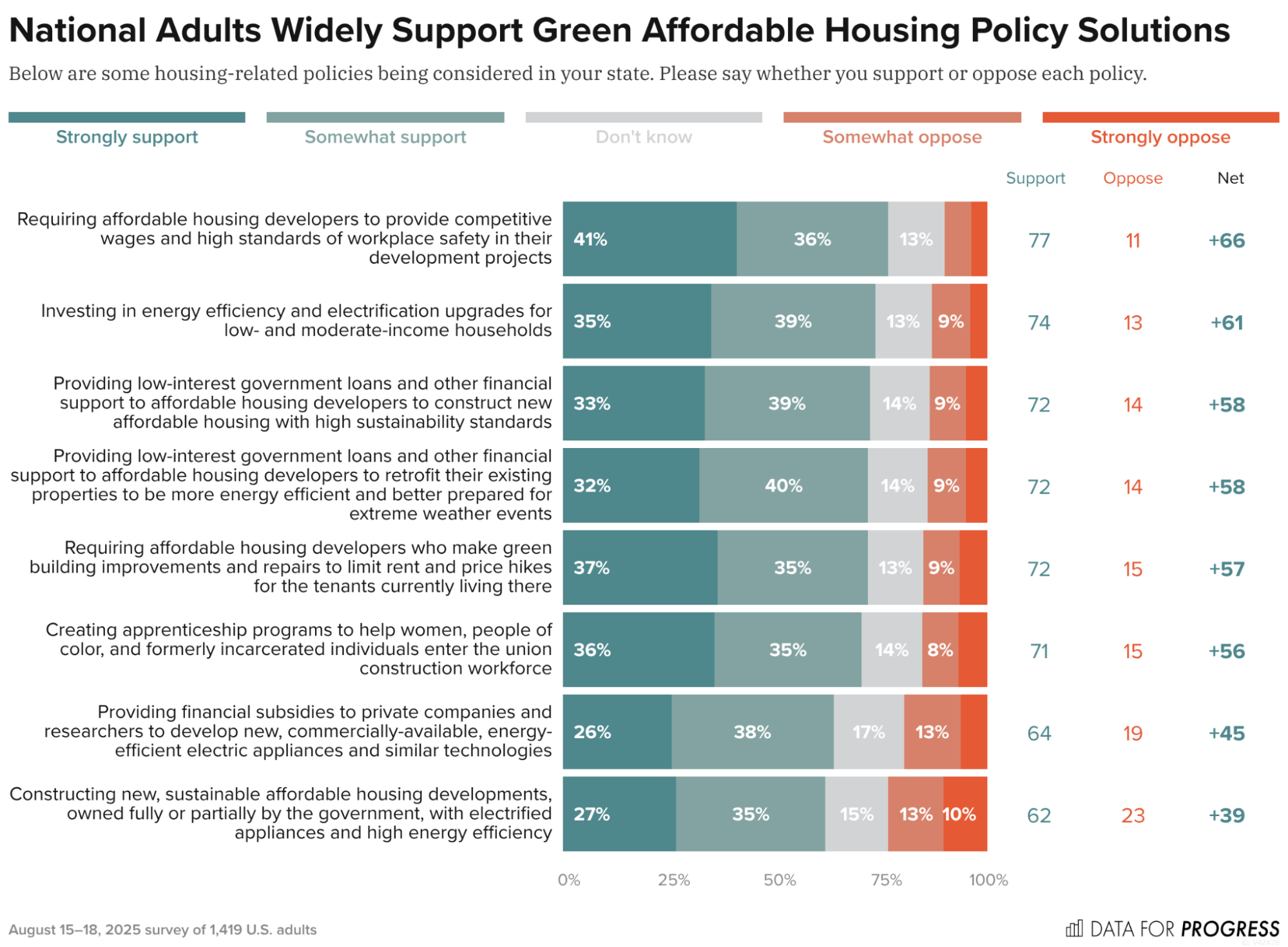
These survey findings underscore the widespread and layered nature of housing precarity in the United States, with a majority of adults — particularly renters, younger people, and people of color — reporting significant financial strain related to housing. While affordable green housing does not yet top the list of public policy priorities for most Americans, there is robust and broad-based support for specific policy interventions that would promote energy efficiency, tenant protections, and fair labor practices in the housing sector. As state and federal policymakers consider strategies to meet housing and climate goals, these results point to both the urgent need and the public will to pursue policies that make affordable, sustainable housing more accessible to all.
Grace Adcox (@GraceAdcox) is the senior climate strategist at Data for Progress.
Survey Methodology
From August 15 to 18, 2025, Data for Progress conducted a survey of 1,419 U.S. adults nationally using web panel respondents. The sample was weighted to be representative of adults by age, gender, education, race, geography, and recalled presidential vote. The survey was conducted in English. The margin of error associated with the sample size is ±3 percentage points. Results for subgroups of the sample are subject to increased margins of error. Partisanship reflected in tabulations is based on self-identified party affiliation, not partisan registration. For more information please visit dataforprogress.org/our-methodology.