According to a leaked budget memo reviewed by NPR, the Trump administration is considering eliminating crisis intervention services for LGBTQ+ youth, a group at significantly increased risk for suicide. According to a 2024 national survey by The Trevor Project, 39% of LGBTQ+ young people had seriously considered attempting suicide in the previous year, including 46% of transgender and nonbinary young people.
In 2022, the federal government established the 988 Suicide and Crisis Lifeline, which enables anyone experiencing a mental health crisis to call or text 988 and be connected with a trained counselor. The 988 Lifeline also offers specialized crisis services for populations at higher risk for suicide, like LGBTQ+ youth and veterans, connecting them directly with crisis counselors who have been specifically trained to support them.
Notably, it was President Donald Trump who originally signed the National Suicide Hotline Designation Act into law toward the end of his first term in 2020. The act officially shortened the hotline’s 10-digit number to 988 and required the Substance Abuse and Mental Health Services Administration to report to Congress on strategies to establish specialized services for LGBTQ+ youth and other high-risk populations.
A new poll from Data for Progress asked voters whether the U.S. government should eliminate the 988 Lifeline’s specialized crisis services for LGBTQ+ youth. A strong majority of voters (69%), including 56% of Republicans, 70% of Independents, and 80% of Democrats, say that the U.S. government should keep these services in place, while less than 1 in 4 voters (23%) say the government should eliminate them.
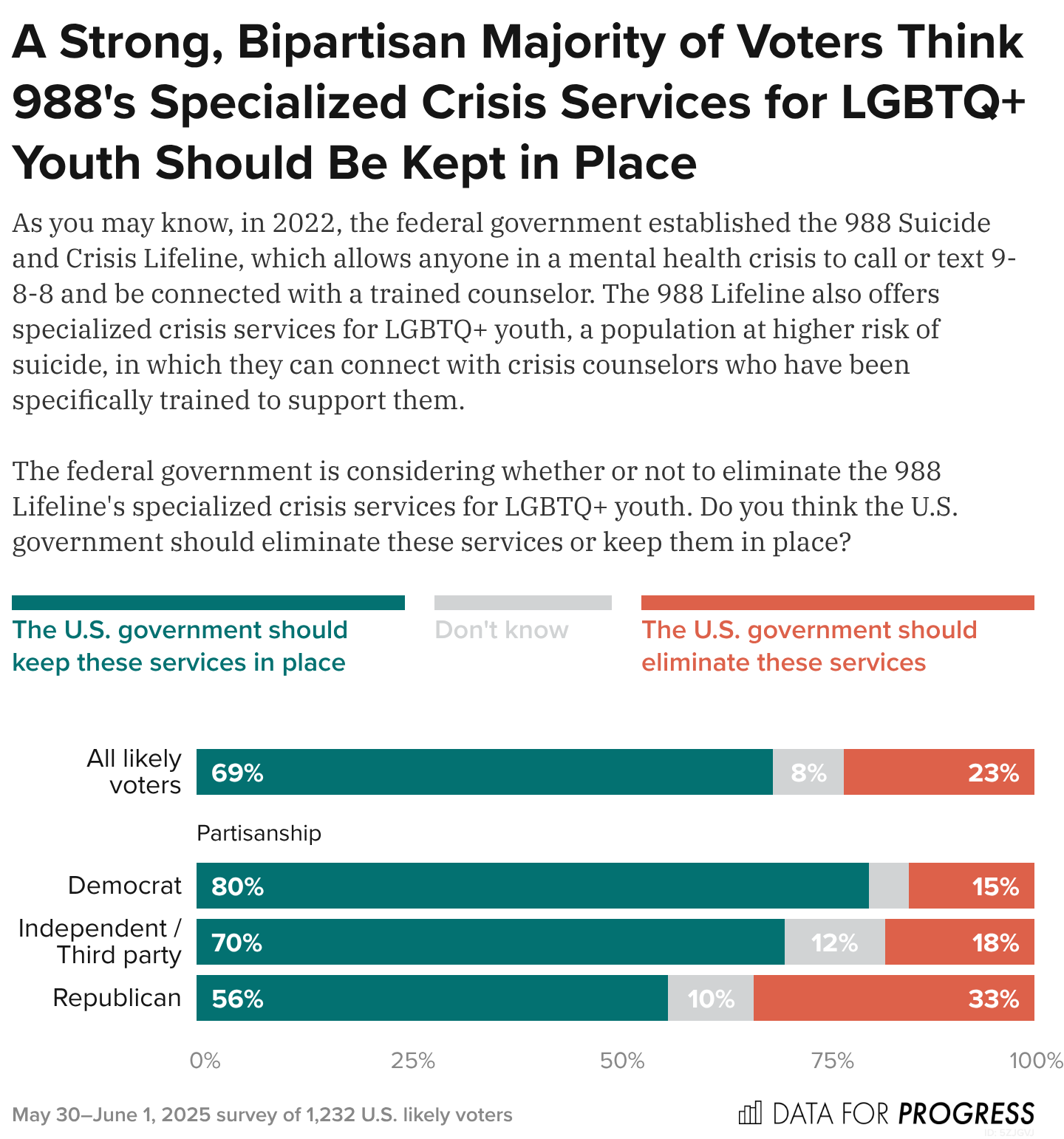
This finding demonstrates that the Trump administration’s proposal to eliminate the 988 Lifeline’s specialized services for LGBTQ+ youth faces wide, bipartisan opposition.
Survey Methodology
From May 30 to June 1, 2025, Data for Progress conducted a survey of 1,232 U.S. likely voters nationally using web panel respondents. The sample was weighted to be representative of likely voters by age, gender, education, race, geography, and recalled presidential vote. The survey was conducted in English. The margin of error associated with the samplesizeis ±3 percentage points. Results for subgroups of the sample are subject to increased margins of error. Partisanshipreflected in tabulations is based on self-identified party affiliation, not partisan registration. For more information pleasevisit dataforprogress.org/our-methodology.