Amid a chaotic tariff rollout and persistent inflation, voters across the country continue to experience the economic downturn and resulting financial hardships facing their households and communities. In line with this, a July 2025 survey of registered Latino voters in the U.S. performed by Data for Progress, in partnership with Equis, finds that these voters believe that the U.S. economy is not doing well and that our current policies are not driving it in the right direction. Instead, these voters want to see their lawmakers pass policies that will alleviate the everyday financial challenges facing working and middle class households and increase taxes on the ultra-wealthy and big corporations to fund such policies.
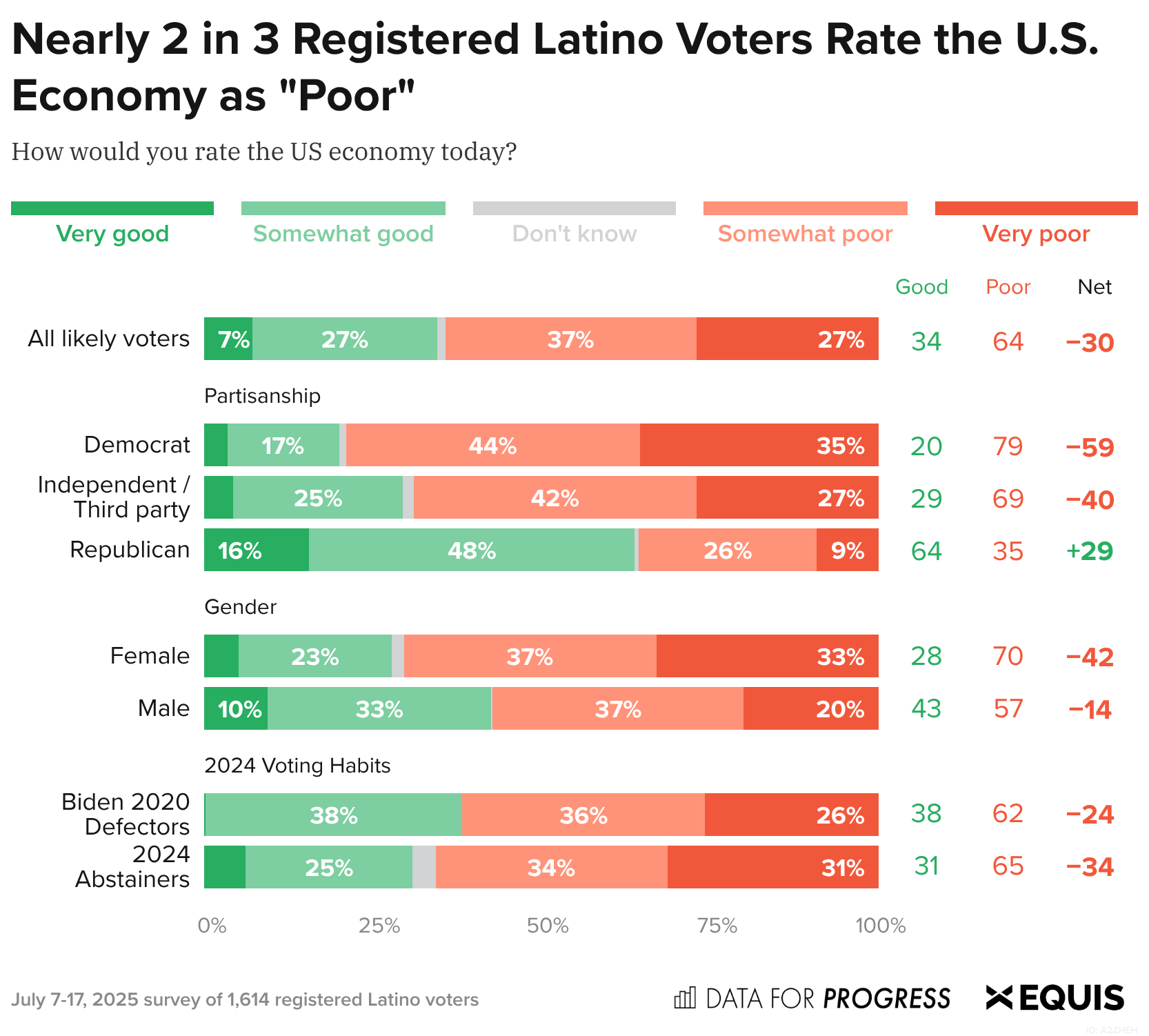
When asked to rate the state of the U.S. economy today, almost two-thirds of registered Latino voters (64%) say the economy is doing “somewhat” or “very” poorly. While Republicans were more likely to have a positive outlook on the economy, strong majorities of both Democrats (79%) and Independents (69%) rate the economy as poor. We also find that strong majorities of voters across gender share this pessimistic view of the economy. Finally, even voters who defected from Joe Biden to Donald Trump between 2020 and 2024 or chose to abstain entirely from voting in the 2024 election are more likely to rate the economy as doing poorly today (62% and 65%, respectively). Together this shows that, regardless of how positively the current administration tries to pitch the current state of the U.S. economy, registered Latino voters are not seeing any such positive outcomes in their daily lives. With a parallel poll of non-Latino respondents similarly showing majorities of respondents rating the U.S. economy as “poor,” it is clear that this negative economic outlook is a widely held perception across the U.S. electorate.
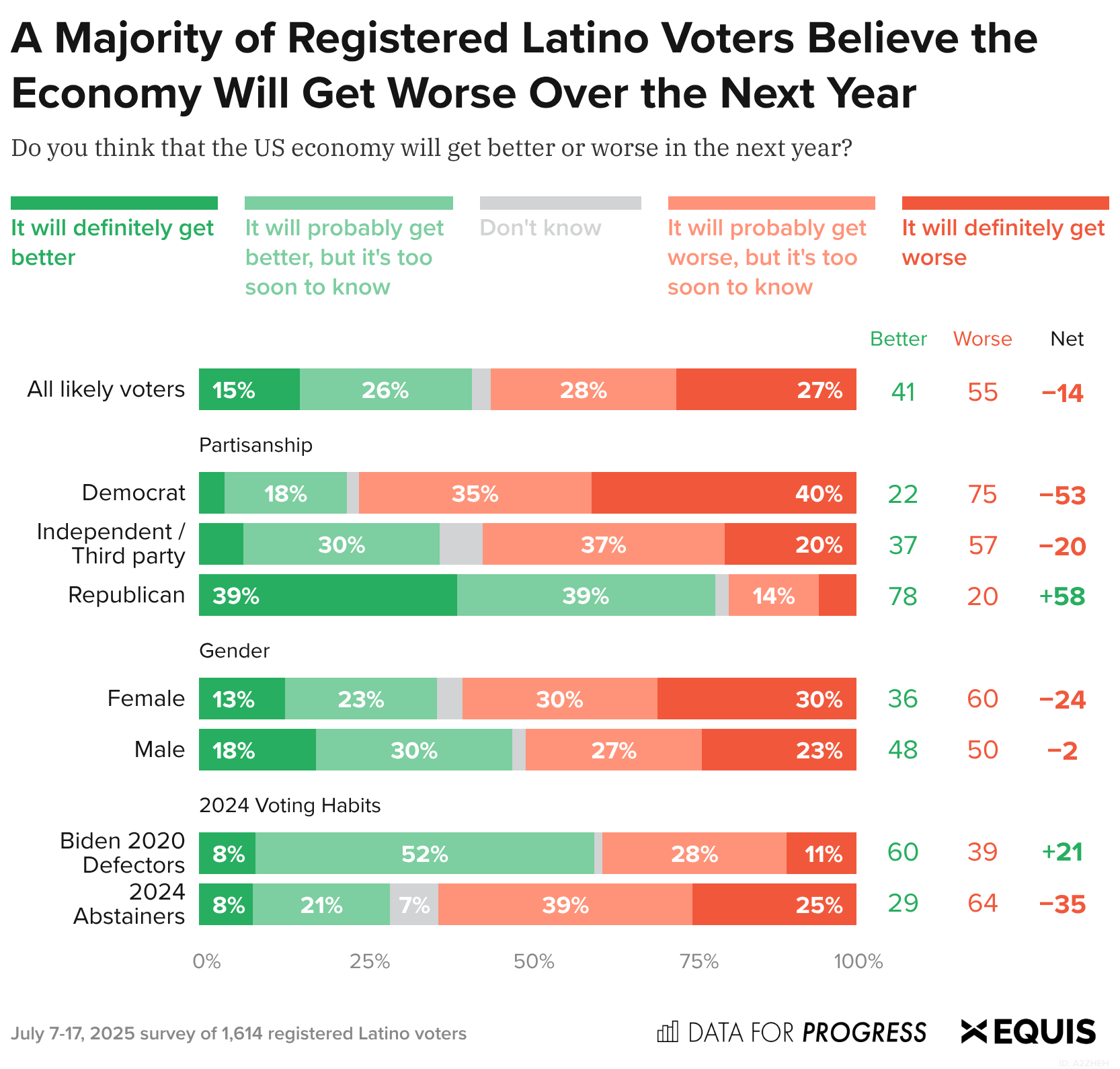
Furthermore, these same voters do not anticipate that economic conditions will improve in the next year. In fact, a majority of registered Latino voters believe that the economy will either “probably” or “definitely” get worse over the course of the next year. Once again, we find that much of this result is driven by partisan attachments, with this sentiment being most strongly held by Democrats (75%), Independents (57%) and women (60%), while Republicans and Biden 2020 defectors remain hopeful about the economy’s future outlook and men are largely split. Together, this suggests that registered Latino voters are, on balance, not convinced that the president and the administration overall is currently on the right track in regards to their economic policies.
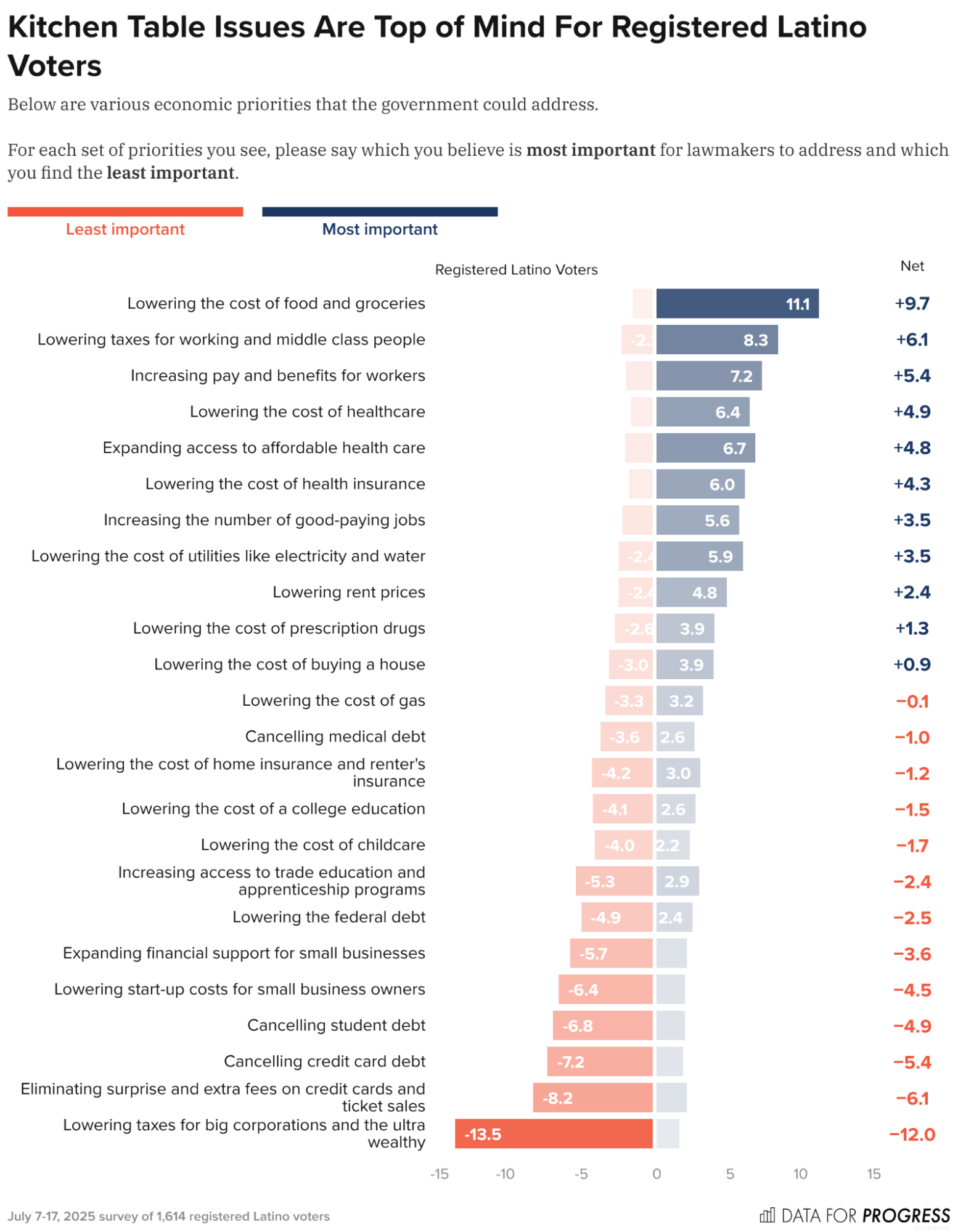
When asked to rank a wide variety of economic priorities from most to least important for lawmakers to address, registered Latino voters rank kitchen table issues and other challenges facing working and middle class families as most important. Specifically, these voters rank lowering grocery costs as their most important priority, followed by lowering taxes for the working and middle class, increasing worker pay and benefits, and making health care more affordable and accessible. In contrast, these voters are most likely to rank lowering taxes for big corporations and the wealthy as their lowest priority for lawmakers to address, underlining their preference for providing economic relief to working class households over tax breaks for the wealthy. With non-Latino voters also ranking lowering grocery costs and taxes for working and middle class households as their top two priorities, lawmakers emphasizing how they are addressing these everyday concerns could have broad appeal with U.S. voters.
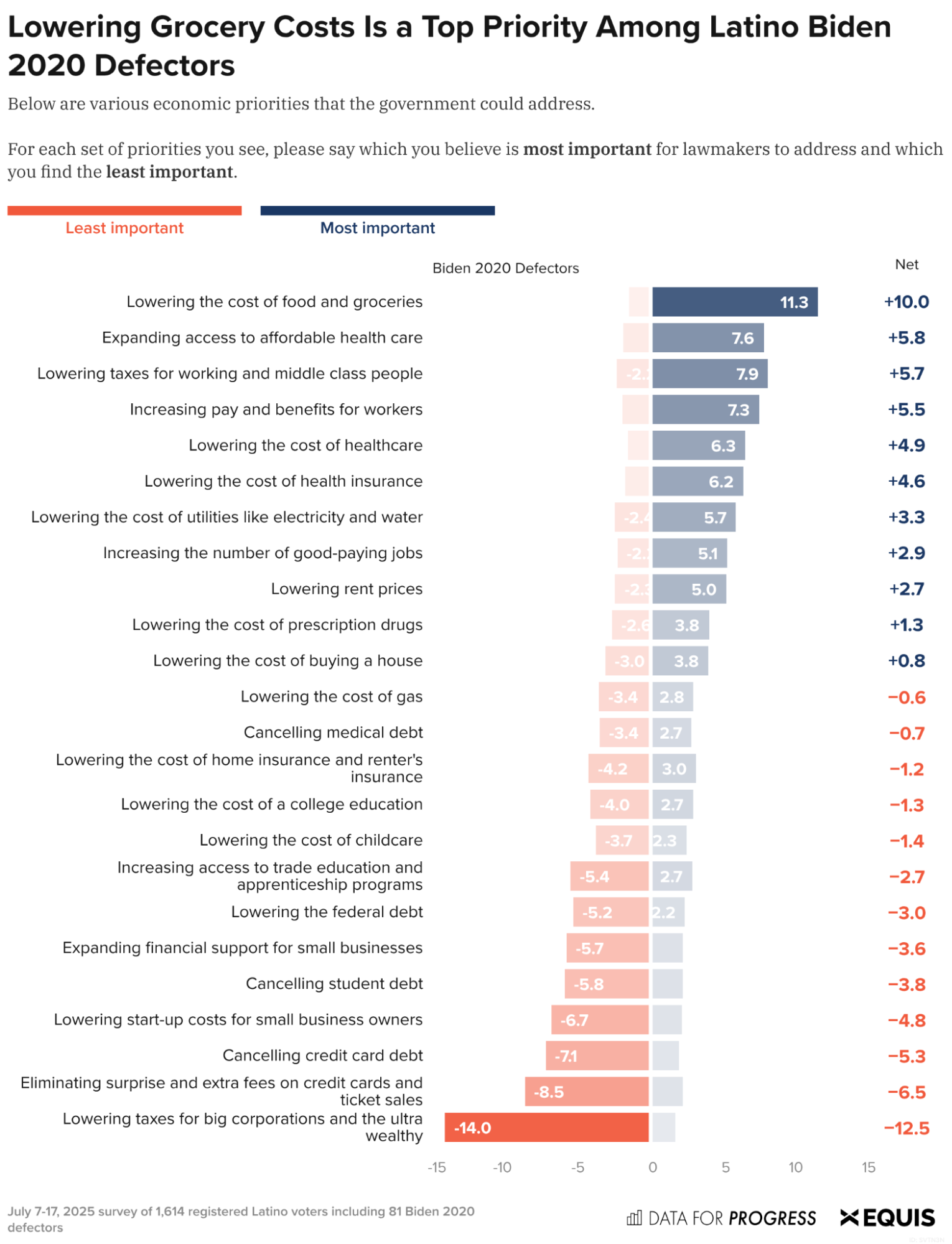
This preference largely holds true among Latino voters who are Biden 2020 defectors. Once again, we see that lowering grocery costs is the top priority among these voters followed by other priorities aimed at reducing the financial burden on working and middle class households. Similar to registered Latino voters overall, Biden 2020 defectors also rank lowering taxes on the ultra-wealthy at the bottom of their priority lists, suggesting that these rankings enjoy consensus among registered Latino voters across the political spectrum.
When asked how they prefer to fund these priorities, Latino voters are overwhelmingly aligned behind ensuring that wealthy individuals and corporations pay their fair share. Strong majorities of these voters support increasing taxes on billionaires (81%) and the ultra-wealthy (78%), while 78% support increasing taxes on “big corporations” and another 70% support closing the tax loopholes that corporations exploit. In contrast, registered Latino voters overwhelmingly oppose making cuts to social programs, research funding, and other public services to fund these priorities. In fact, 80% of these voters oppose making cuts to programs like Medicaid and Social Security, while 76% and 67% oppose making cuts to SNAP funding and research grants, respectively. With overwhelming majorities of registered non-Latino voters also supporting increasing taxes on billionaires and opposing cuts to social programs, it is clear that these preferences are not unique to registered Latino voters.
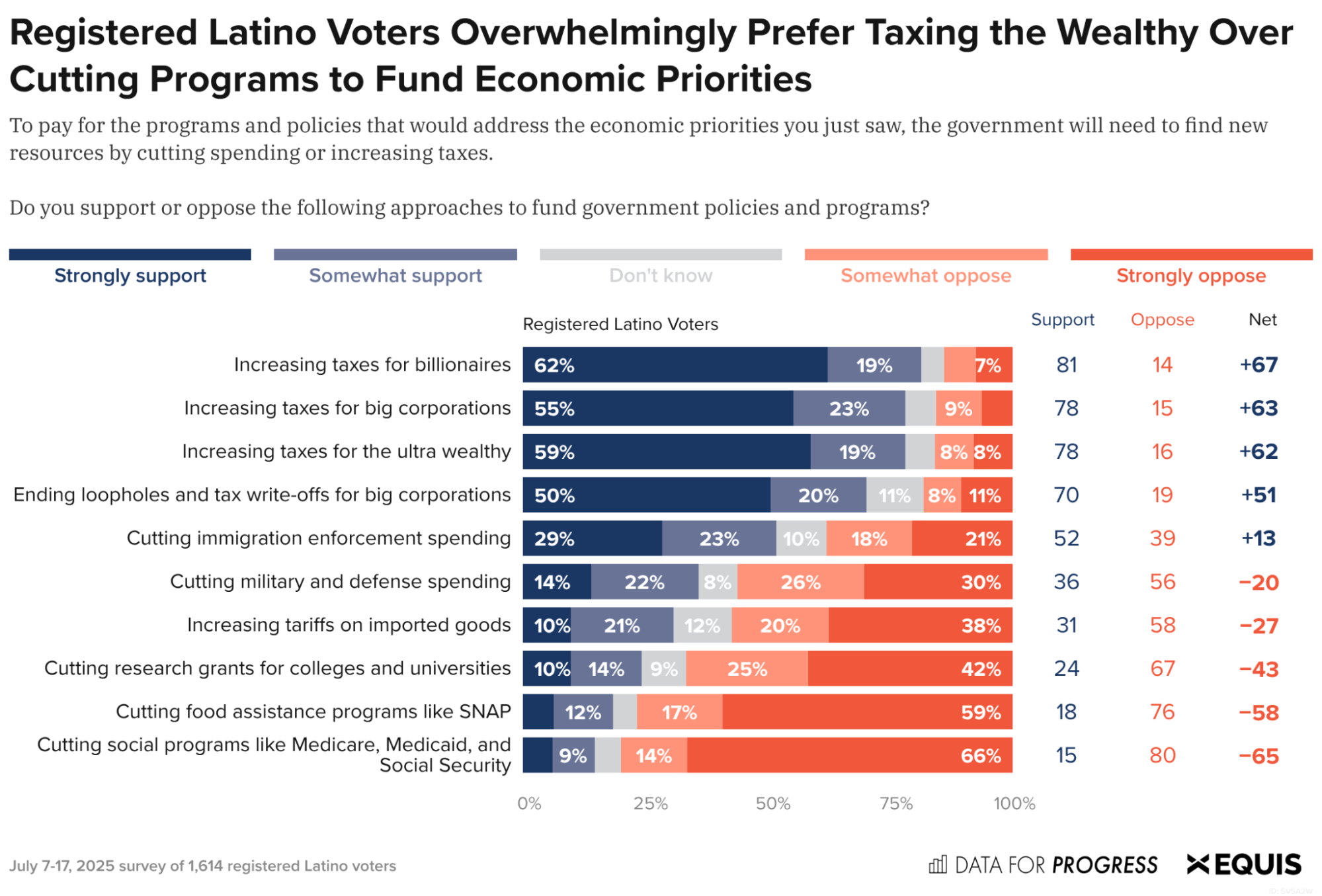
These results show strong alignment among registered Latino voters on their economic priorities. They believe that current policies are not resulting in positive outcomes for their families or their communities, and they are ready to see their lawmakers step up to help working and middle class households, protect critical social programs, and hold the ultra-wealthy accountable for paying their fair share.
Survey Methodology
From July 7 to 17, 2025, Data for Progress, in partnership with Equis, conducted a survey of 1,614 U.S. registered Latino voters nationally using web panel respondents. The sample was weighted to be representative of Latino registered voters by age, gender, education, race, geography, and recalled presidential vote. The survey included oversamples of a pooled set of AZ, NM, and NV. It also included oversamples of the following pooled congressional districts: CA-03, CA-09, CA-13, CA-22, CA-27, CA-40, CA-41, CA-45, CA-47, AZ-01, AZ-06, NV-03, NM-02, CO-08, TX-28, TX-34, TX-15, NJ-07, NJ-09, NY-03, NY-04, NY-17, PA-07, PA-08. The oversamples were weighted to ensure proportional representation of registered voters. The survey was conducted in English and Spanish. The margin of error associated with the sample size is ±2 percentage points. Results for subgroups of the sample are subject to increased margins of error. For more information please visit https://dataforprogress.org/our-methodology.
Data for Progress conducted message testing through maximum difference scaling (MaxDiff) to determine the ordinal ranking of 24 priorities. Respondents were shown a randomized subset of 4 of the priorities, and asked to pick the most and least important priority from those options. They were then asked to do the same across multiple rounds, each time with a new set of 4 randomized priorities.
Using these responses, we project what percentage of registered voters would select each priority as the most important and what percentage of registered voters would select each priority as the least important from the full set of priorities. The scores below represent net importance of each priority — meaning, the projected percentage of registered voters viewing a certain priority as the most important, minus the projected percentage viewing it as the least important.