This year has brought record-breaking heat domes across the central and eastern U.S., catastrophic flash floods in Texas that swept away homes and RVs, and devastated a summer camp community, and destructive wildfires in Southern California that leveled thousands of homes. These disasters are becoming more frequent and are driving up costs that average people are forced to bear. As families across the U.S. shoulder this financial burden, states like New York and Vermont have passed “ climate superfund” laws, and several others have introduced similar proposals — measures that require polluting industries to pay for a share of climate damages caused by their emissions. Now, these laws face opposition from the federal government, which is moving to strike them down or otherwise shield polluters from legal accountability. Despite these developments, polls consistently show voters overwhelmingly support efforts to hold polluters accountable for mounting climate damages.
In a new poll of national likely voters, Data for Progress and Fossil Free Media find that nearly half of respondents say they or someone they know has personally experienced extreme heat waves in the past five years, and most believe these events are becoming more frequent. Voters are especially concerned about rising insurance rates, and many also expect climate change to impact everyday costs like utilities and groceries.
Against this backdrop, voters overwhelmingly support requiring oil and gas companies to pay their share of climate damages, including through a climate superfund law, and are more likely to support candidates who back those measures. These views are consistent with earlier polling and, in several cases, reflect increased levels of concern and support over time. This support is broad across demographics and partisan lines, including with majorities of Republicans who back polluter accountability, suggesting that public appetite for such action is durable and growing.
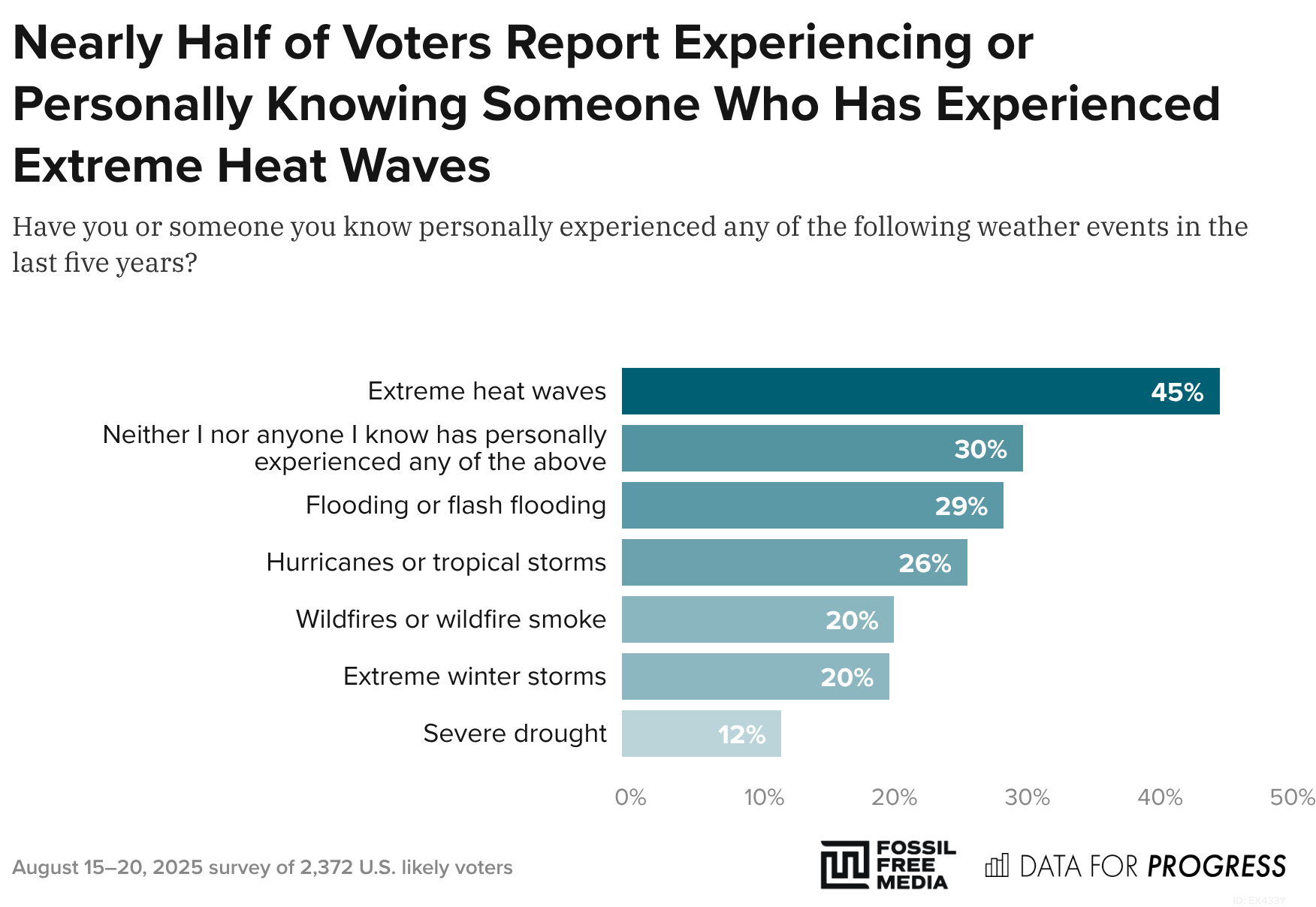
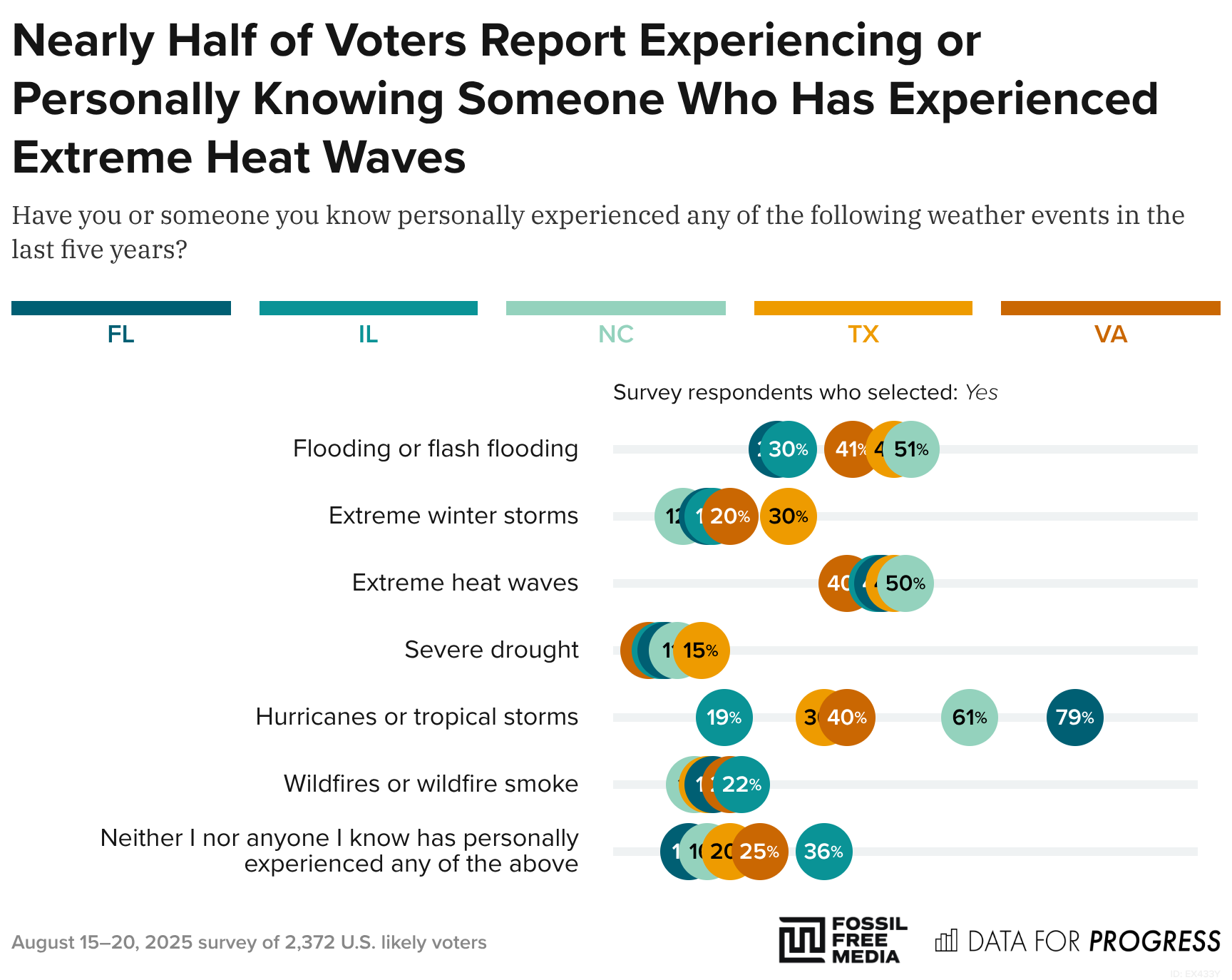
When asked about extreme weather, nearly half of voters (45%) report that they or someone they know personally has experienced extreme heat waves in the last five years, while about 3 in 10 say the same about flooding or flash flooding. In states that were oversampled for this survey, the toll is especially stark: About half of North Carolina and Texas voters report experience with flooding, nearly 4 in 5 Floridians and 3 in 5 North Carolinians say the same about hurricanes or tropical storms, and in every state, at least 2 in 5 voters report that they or someone they know has experienced extreme heat waves.
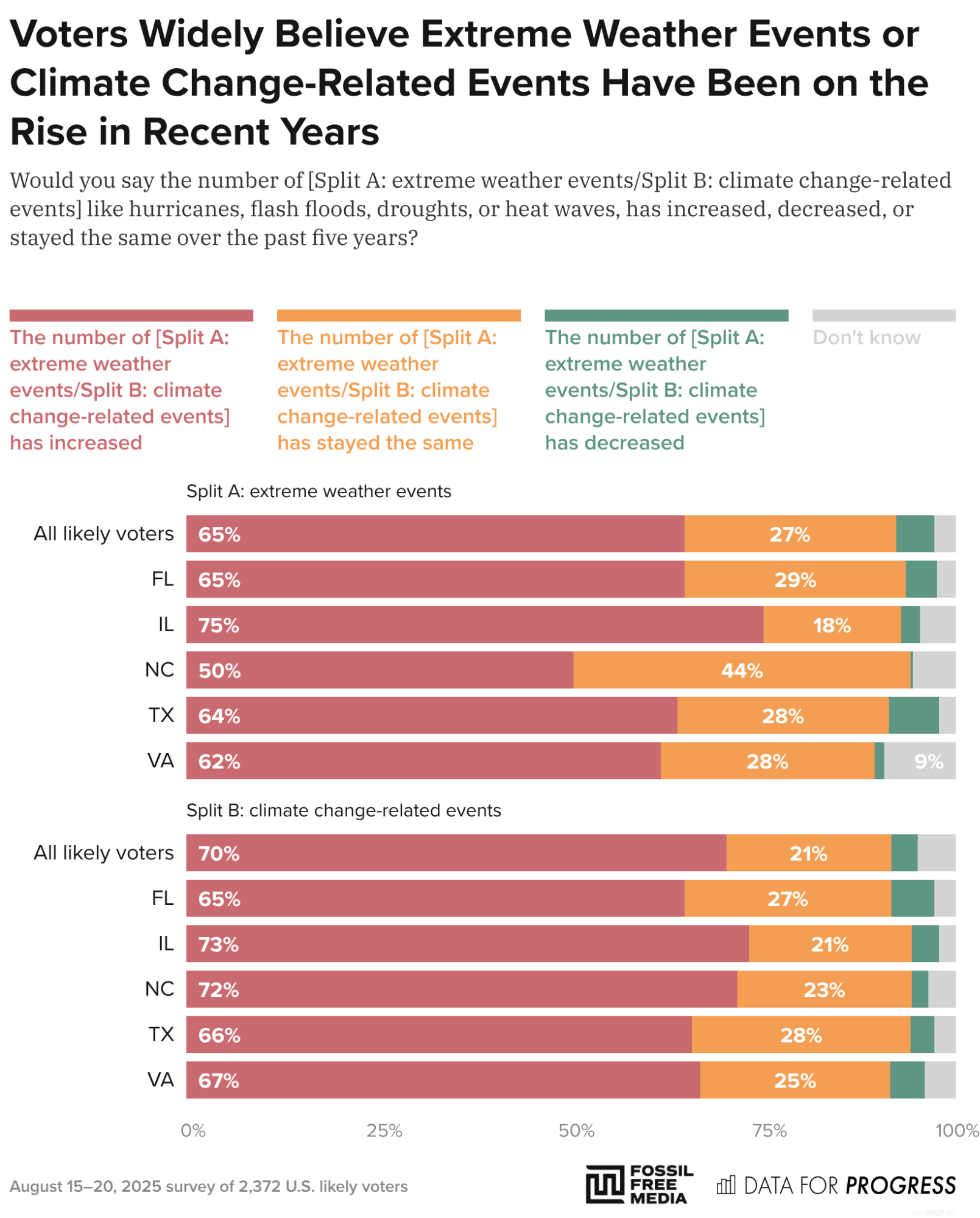
These experiences align with broader perceptions of a shifting climate. In an A/B split sample, one group of voters was asked whether extreme weather events have increased, decreased, or stayed the same in the past five years; around two-thirds (65%) say such events have increased. When the question was framed as climate change-related events, that number rises to 70%. Across both versions, majorities of Democrats, Independents, and Republicans say these events are becoming more frequent.
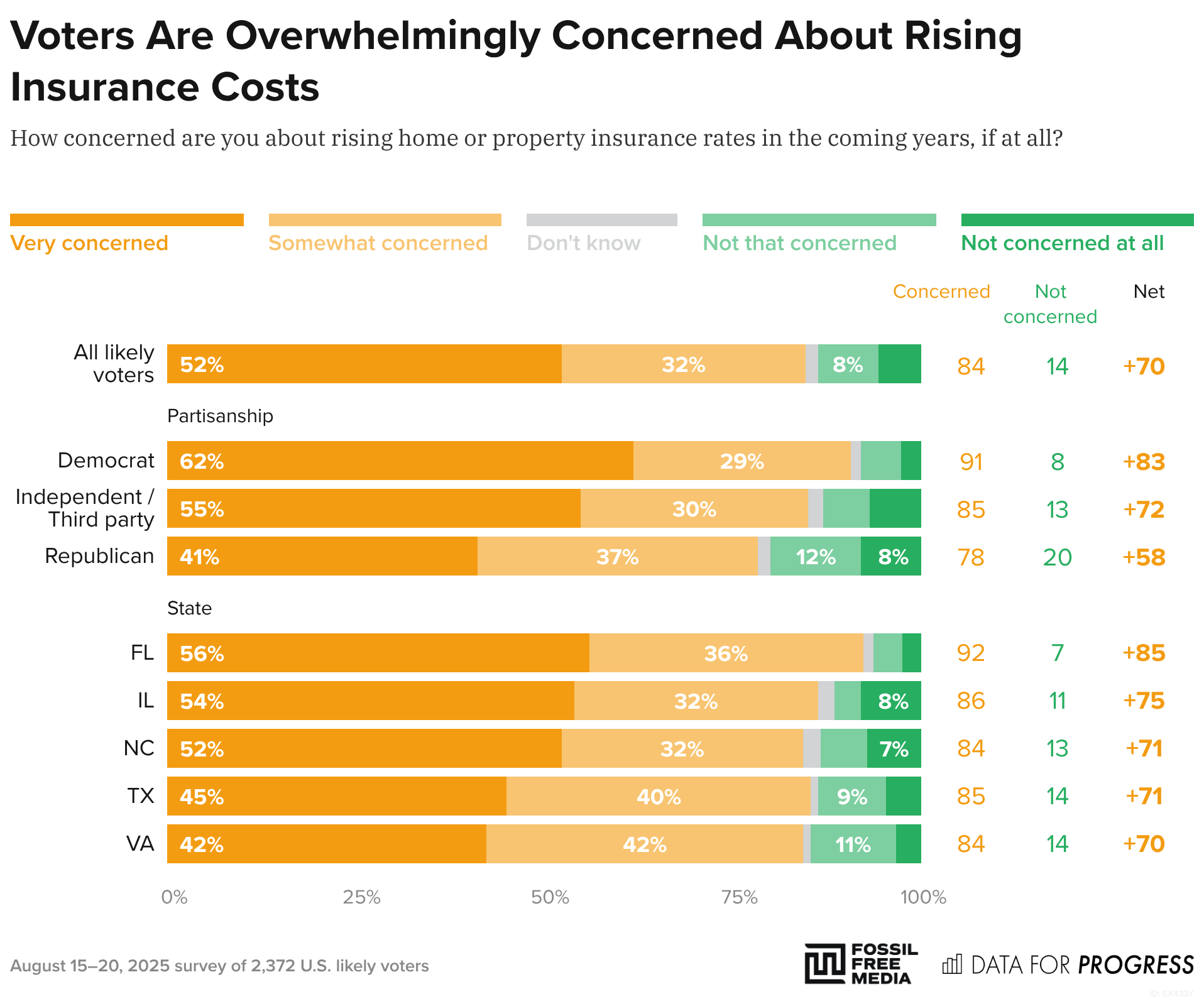
The survey also finds that a strong majority of voters (84%) say they are concerned about rising home and property insurance rates in the coming years — a bipartisan sentiment, with 91% of Democrats, 85% of Independents, and 78% of Republicans expressing concern. Concern is high across all oversampled states, and nearly universal in Florida, where more than 9 in 10 voters say they are concerned about higher insurance costs in the coming years.
These findings mark an uptick in concern when compared with a similar question asked in a March 2025 poll, where 78% of voters said they were concerned about future increases in insurance rates.
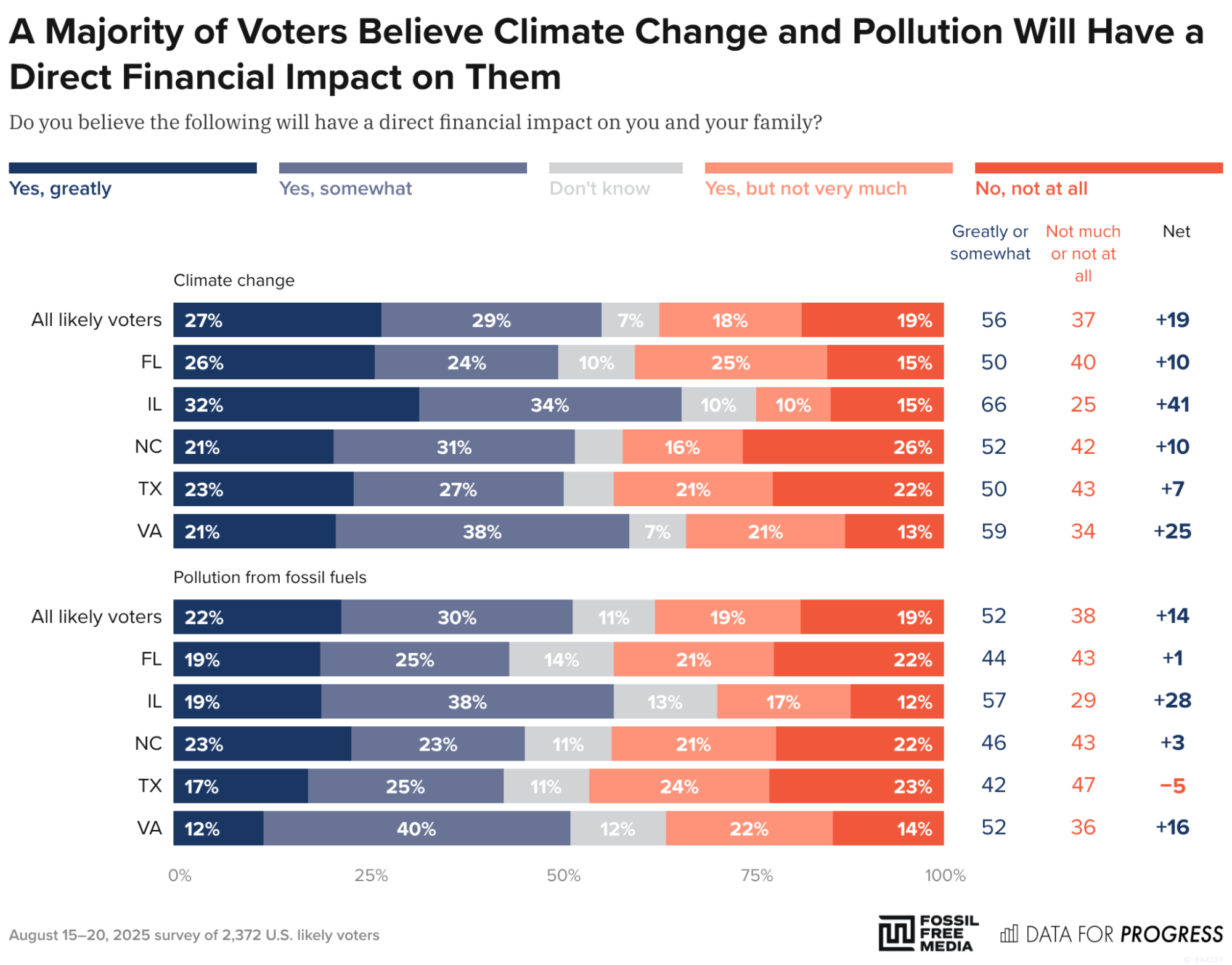
Looking more broadly, a majority of voters believe both climate change (56%) and fossil fuel pollution (52%) will directly affect their household finances, views consistent with an earlier poll from this year. Views follow clear partisan patterns: More than two-thirds of Democrats and just over half of Independents expect financial impacts, while a majority of Republicans say these factors will have little to no effect.
State results mirror these partisan divides. In bluer states like Illinois and Virginia, voters are far more likely to expect financial impact; two-thirds in Illinois (66%) and nearly 3 in 5 in Virginia (59%) say climate change will affect their household finances. In more conservative states such as Texas, Florida, and North Carolina, voters are more split, with about an equal share saying climate change will have an impact on their finances as those who say it will have little or no impact. The same pattern holds for fossil fuel pollution: Majorities in Illinois and Virginia expect financial effects, while respondents are generally split in the more Republican-leaning states.
Among voters who do expect financial effects, large majorities point to higher utility bills (73%), grocery bills (68%), and gas prices (65%). Many also anticipate increases in health care costs, housing costs, and property maintenance expenses.
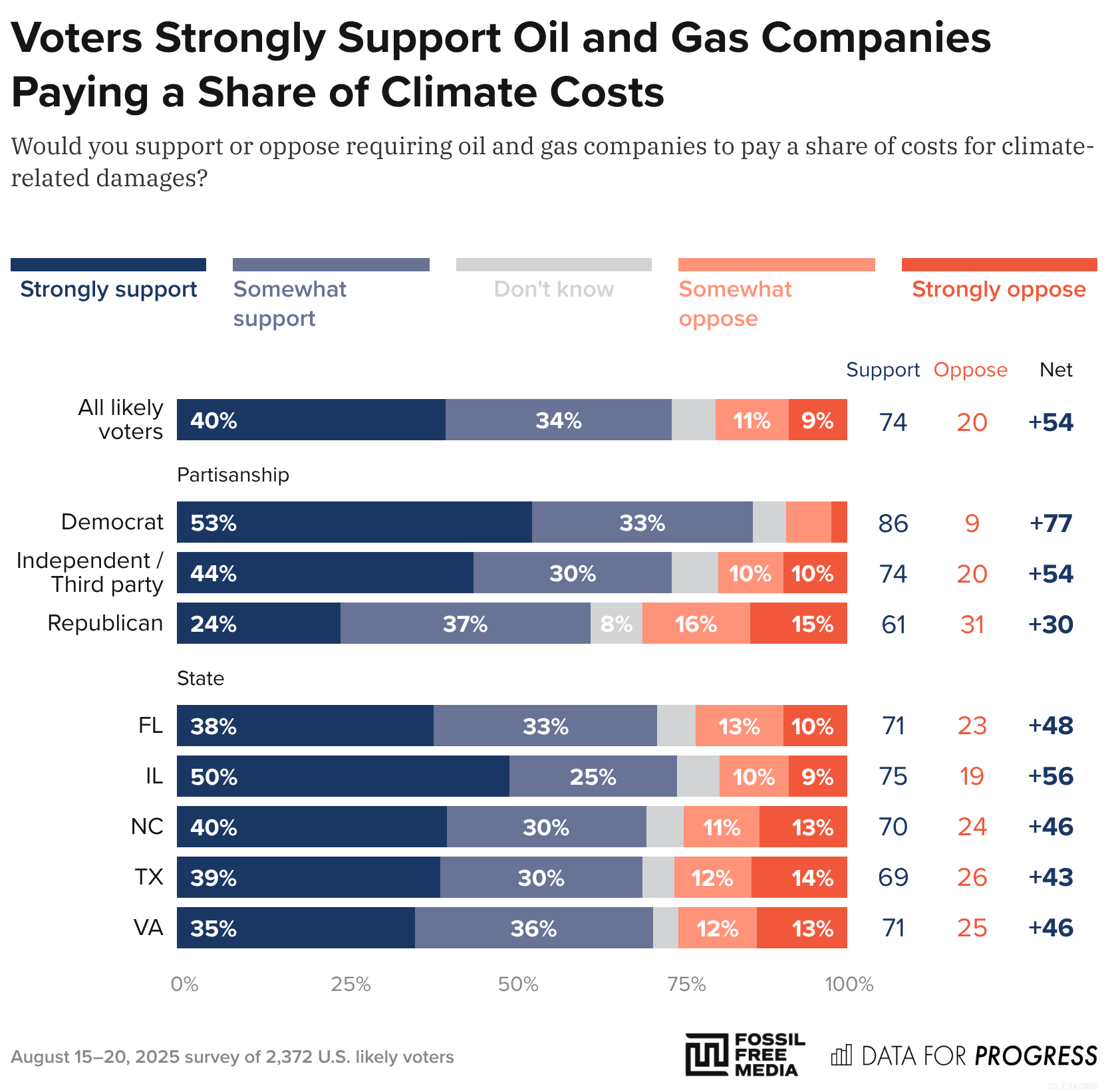
Building on these findings, voters back action to ensure oil and gas companies shoulder responsibility for the damages their products cause. Roughly three-quarters of voters (74%) support requiring oil and gas companies to pay a share of climate-related costs, including 86% of Democrats, 74% of Independents, and 61% of Republicans. Support is also broad across the oversampled states, with more than two-thirds of voters in each saying oil and gas companies should be required to cover a share of climate damages. These findings are also consistent with polling from the spring, when 71% of voters supported such a requirement, underscoring broad and stable support for holding fossil fuel polluters accountable.
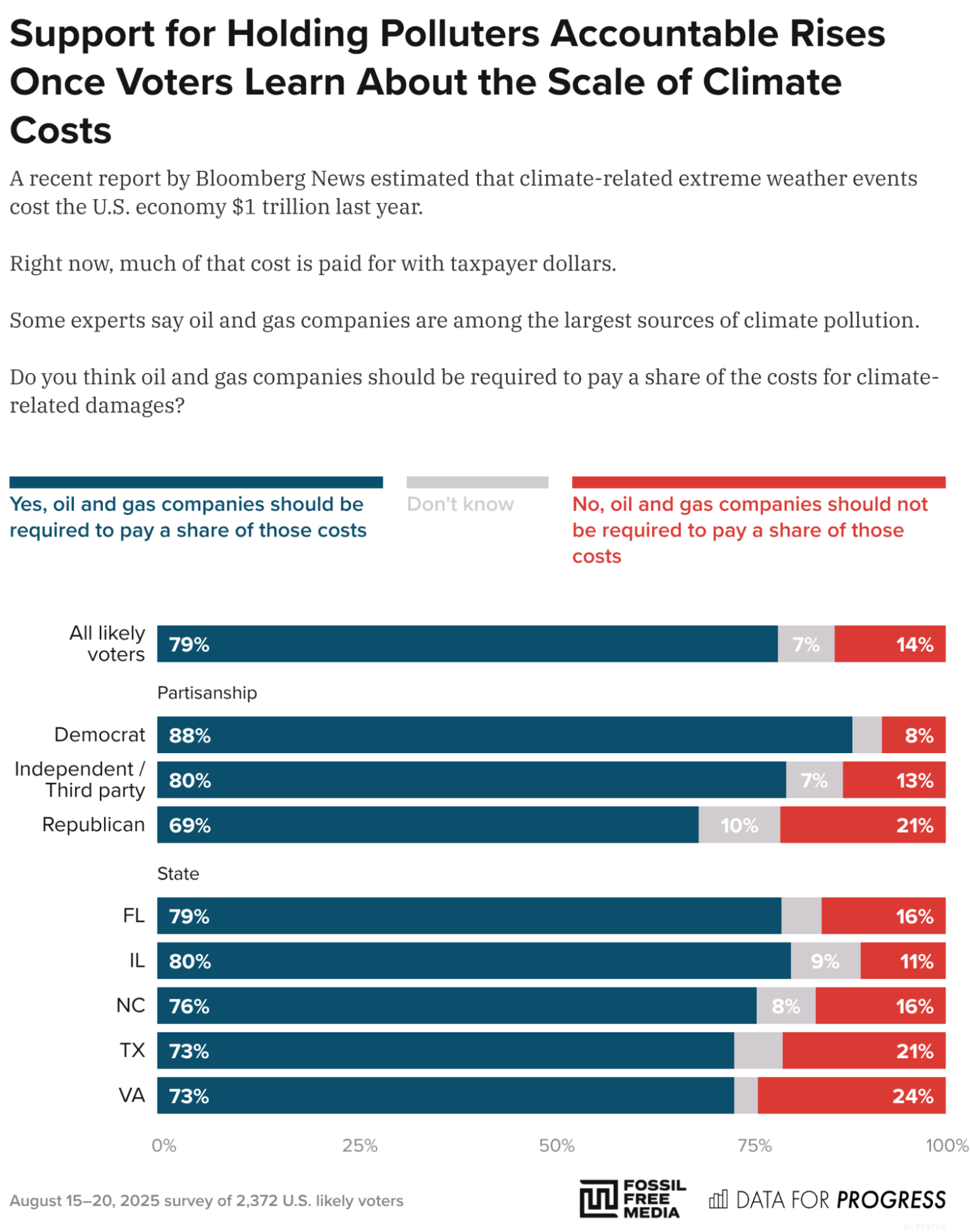
Indeed, when voters read that climate-related extreme weather events cost the U.S. economy $1 trillion last year, and that these costs are shouldered primarily by taxpayers, support for holding polluters accountable grows even stronger. Nearly 4 in 5 voters (79%) say oil and gas companies should be required to pay for climate damages, including 88% of Democrats, 80% of Independents, and 69% of Republicans.
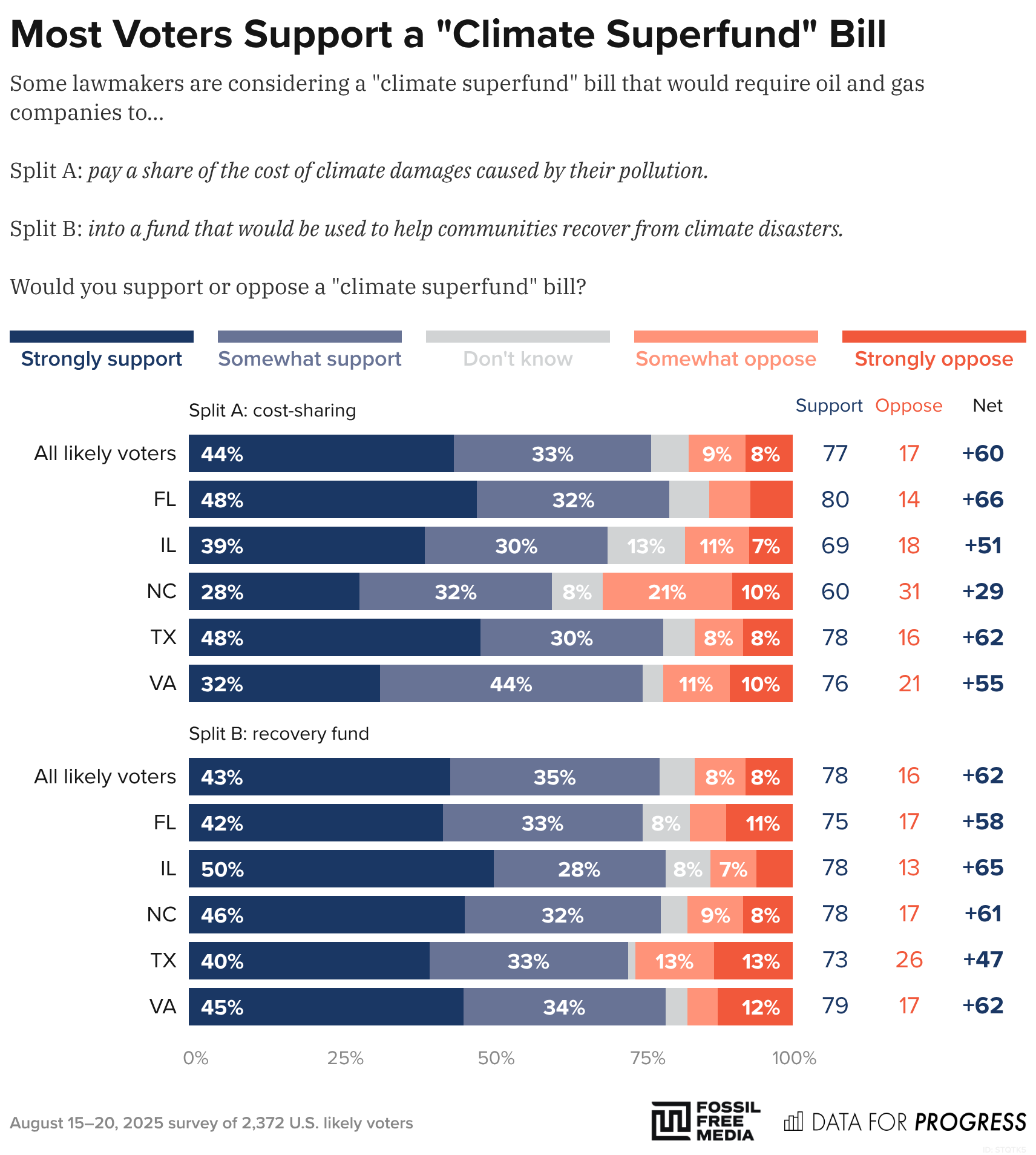
This broad consensus translates directly into support for legislative action. In an A/B split sample, voters were asked about a proposed “climate superfund” bill in two different ways: One framing emphasized requiring oil and gas companies to pay a share of the cost of damages caused by their pollution (Split A), while the other emphasized requiring them to pay into a fund that would help communities recover from climate disasters (Split B).
In both cases, support is overwhelming. Under the cost-sharing frame, 77% of voters express support, including 89% of Democrats, 78% of Independents, and 64% of Republicans. Under the recovery fund frame, support remains nearly identical at 78% overall, and 89%, 80%, and 66% among Democrats, Independents, and Republicans, respectively.
State-level results reinforce the breadth of this support. In both Illinois and North Carolina, 78% of voters back the recovery fund framing, while support in Florida (75%), Texas (73%), and Virginia (79%) is also strong. Under the cost-sharing framing, support is highest in Florida (80%) and Texas (78%), with majorities in all oversampled states backing the measure.
Across both split sample groups, there is a marked increase in climate superfund support when compared with polling from 2024, when 66% of voters said they would support a "climate superfund" bill that would require oil and gas companies to pay a share of the cost of climate damages caused by their pollution.
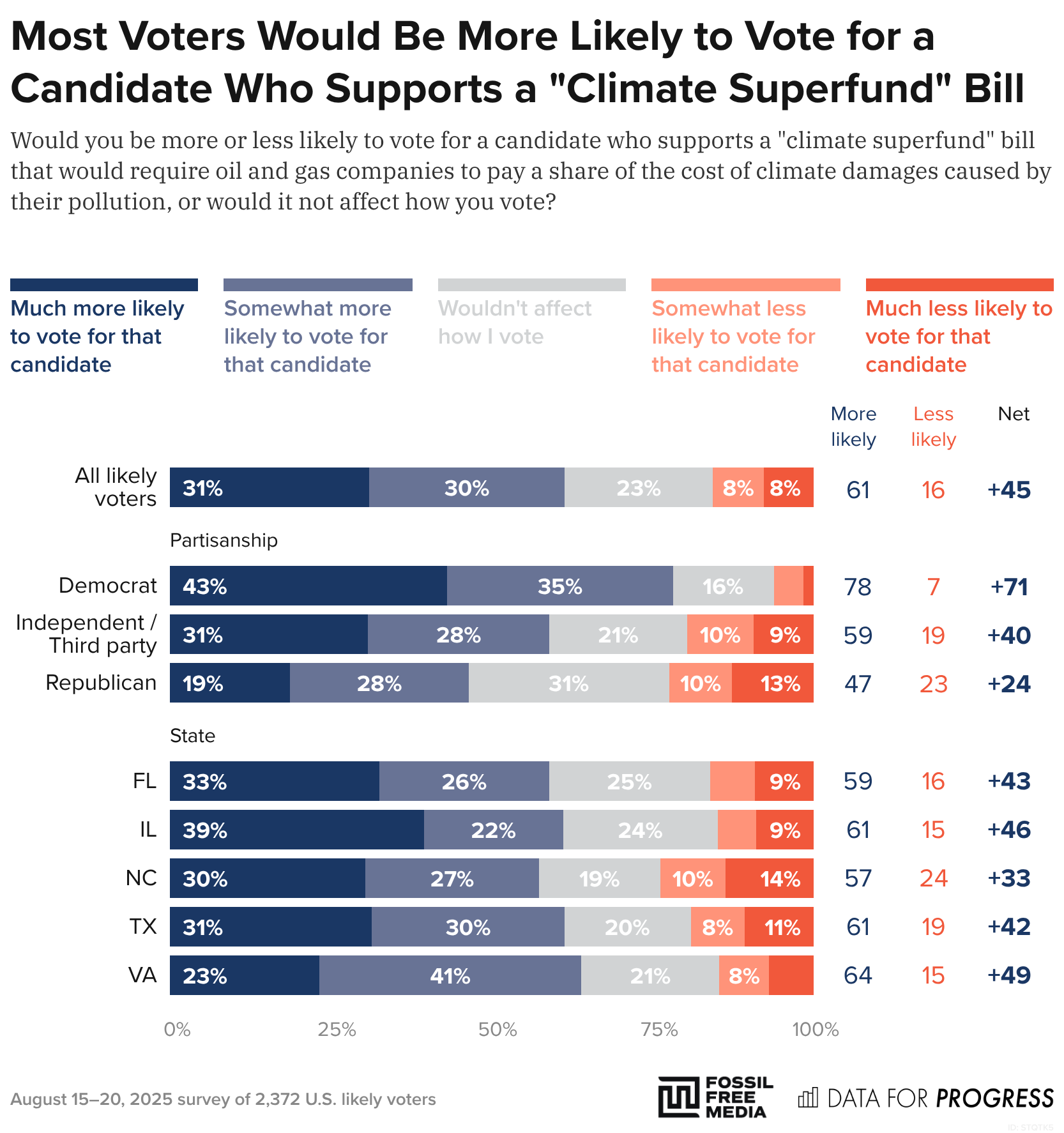
Voters also say that support for a climate superfund bill could influence their choices at the ballot box. Sixty-one percent report they would be more likely to support a candidate who backed such a measure, compared with just 16% who say they would be less likely. This includes nearly 4 in 5 Democrats (78%), about 3 in 5 Independents (59%), and nearly half of Republicans (47%).
State-level results are consistent: In each of the oversampled states, large majorities say they would be more likely to support a candidate who favored a climate superfund bill.
Compared with April 2024, when 50% of voters said they would be more likely to support a candidate who backed a superfund bill and 22% said they would be less likely, the latest results point to a clear increase in support. Because the earlier poll included a “don’t know” option, some of that change reflects differences in question design, but the overall movement still indicates real growth in support for candidates who support these efforts.
Together, these results show that supporting polluter accountability carries broad electoral appeal, with significant support even among Republican voters typically seen as more aligned with the oil and gas industry.
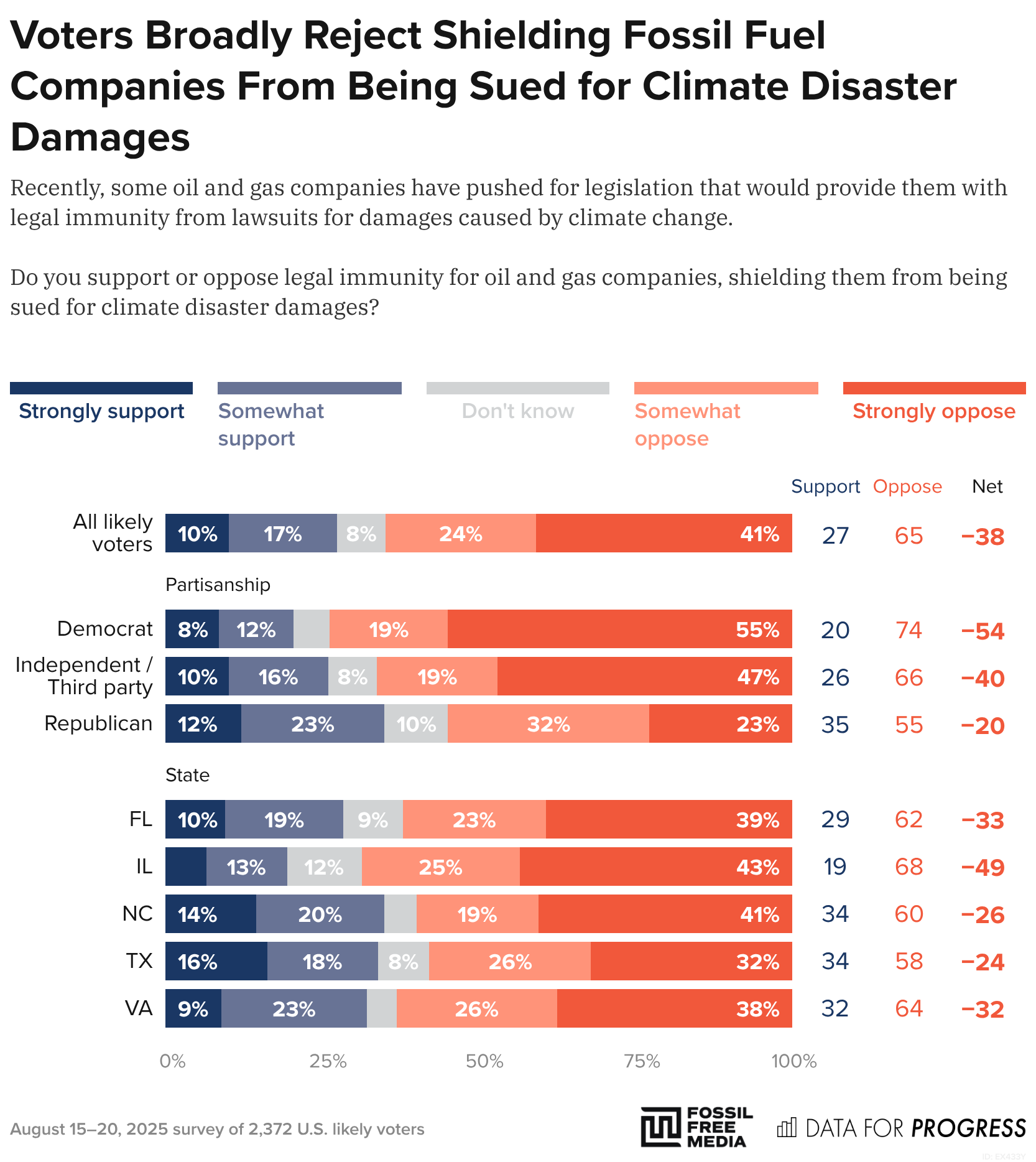
Finally, the survey also finds that 65% of voters overall** oppose** granting legal immunity to oil and gas companies, which would shield them from being sued for damages related to climate disasters. Opposition includes 74% of Democrats, 66% of Independents, and 55% of Republicans.
This mirrors findings from a March 2025 survey, where 65% of voters also opposed immunity, underscoring that voter opposition to protections for polluters remains steady.
Notably, industry groups and some elected officials are pushing for legislation granting legal immunity to oil and gas companies, a move that would run counter to bipartisan public sentiment on the issue.
Overall, the findings show that voters are feeling the effects of climate change, expect costs to rise, and believe oil and gas companies should pay their fair share. Across parties and states, support for polluter accountability is broad and consistent.
Survey Methodology
From August 15 to 20, 2025, Data for Progress conducted a survey of 2,372 U.S. likely voters nationally using web panel respondents. The sample was weighted to be representative of likely voters by age, gender, education, race, geography, and recalled presidential vote. This sample was also weighted to account for oversamples in Florida, Illinois, North Carolina, Texas, and Virginia with unweighted Ns of 300 each, to ensure proportional representation of likely voters. Please note, the N size displayed in the crosstabs represents weighted N, not unweighted N, hence displayed totals may appear smaller than the actual respondent count listed above. The survey was conducted in English. The margin of error associated with the sample size is ±2 percentage points. Results for subgroups of the sample are subject to increased margins of error. Partisanship reflected in tabulations is based on self-identified party affiliation, not partisan registration. For more information, please visit dataforprogress.org/our-methodology.
Persuadable voters are respondents who say that they "normally vote about equally for both major parties."