Experts increasingly warn that the world will likely not meet the target set by the Paris Agreement to limit global warming to 1.5 degrees Celsius. Indeed, climate models suggest the world is on track to overshoot 1.5 C, with dire consequences. As Los Angeles starts the long road to recovery from devastating climate-fueled wildfires — potentially the costliest fire disaster in U.S. history — mitigating future climate impacts requires not only rapidly decarbonizing the economy, but also reversing past emissions by using carbon dioxide removal (CDR) technologies.
CDR refers to the process by which carbon dioxide (CO2) is removed directly from the air using a variety of strategies, from nature-based solutions, like afforestation, to more technological strategies, like using large fans to suck CO2 from the air. CDR encompasses a suite of technologies, including direct air capture, biomass carbon removal and storage, and ocean alkalinity enhancement.
Building on nearly five years of research on CDR, Data for Progress surveyed 1,270 likely voters from January 24-27, 2025, to understand attitudes toward CDR, finding most voters still are largely unfamiliar with carbon removal.
In fact, a majority of voters (63%) report having heard “nothing at all” about carbon removal, compared with 7% and 31% who report having heard “a lot” or “a little,” respectively.
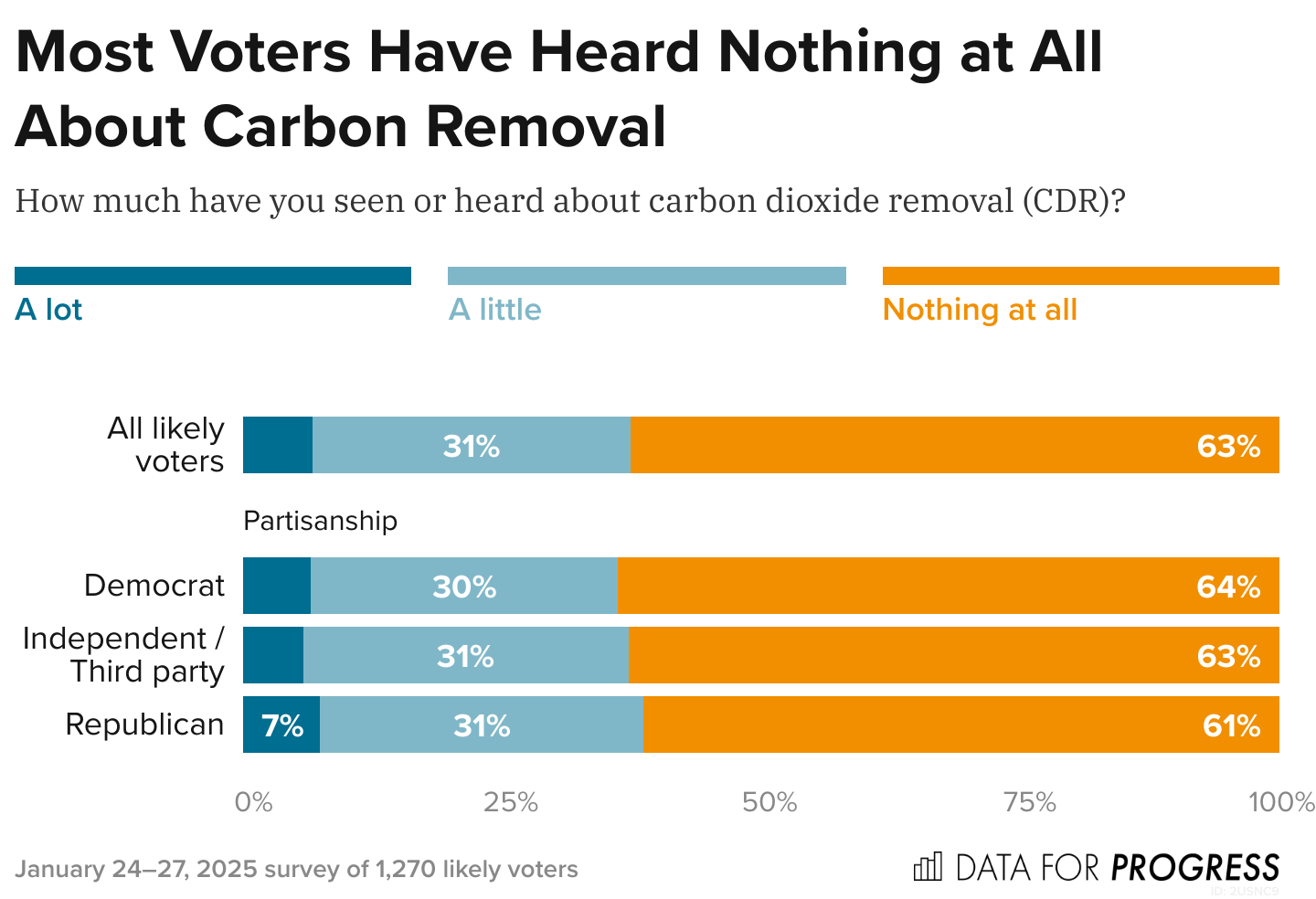
However, among voters who report hearing either a lot or a little about carbon removal, a bipartisan majority (56%) have a favorable opinion of it. Those who report having heard about carbon removal most often say they’ve heard about it from national broadcast television (32%) and social media (25%), relative to other sources.
Respondents were then asked to read the following passage describing carbon removal before answering the remaining questions:
The next series of questions will ask you about carbon removal, which is the process of removing carbon from the atmosphere using technologies (like large filters) or approaches that help store more CO2 in soils and trees. *
Humans have burned fossil fuels like coal, oil, and gas for electricity, heat, and transportation since the mid-1800s. Burning these fuels has released a significant amount of carbon dioxide (CO2) pollution into the atmosphere. Carbon dioxide traps the sun’s heat and warms the Earth like a blanket. As human activities have increased, so has the layer of carbon dioxide pollution, leading to overall warmer temperatures and changes in the atmosphere that increase the likelihood of extreme weather.*
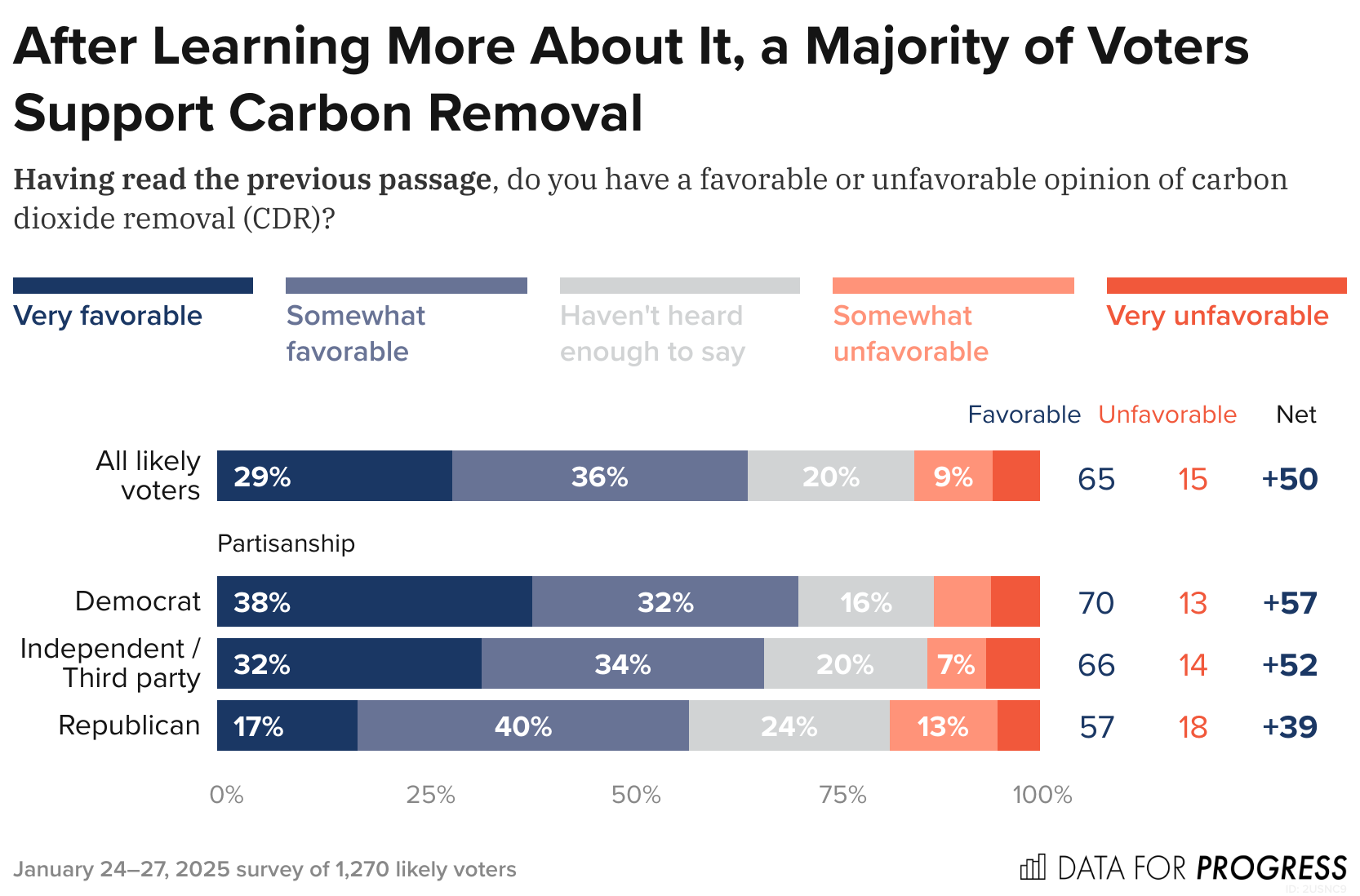
After reading this information, nearly two-thirds of voters (65%) say they have a favorable opinion of carbon removal. This includes 70% of Democrats, 66% of Independents, and 57% of Republicans. These findings mirror strong support for CDR found in surveys of likely voters and American adults in 2021 and 2023.
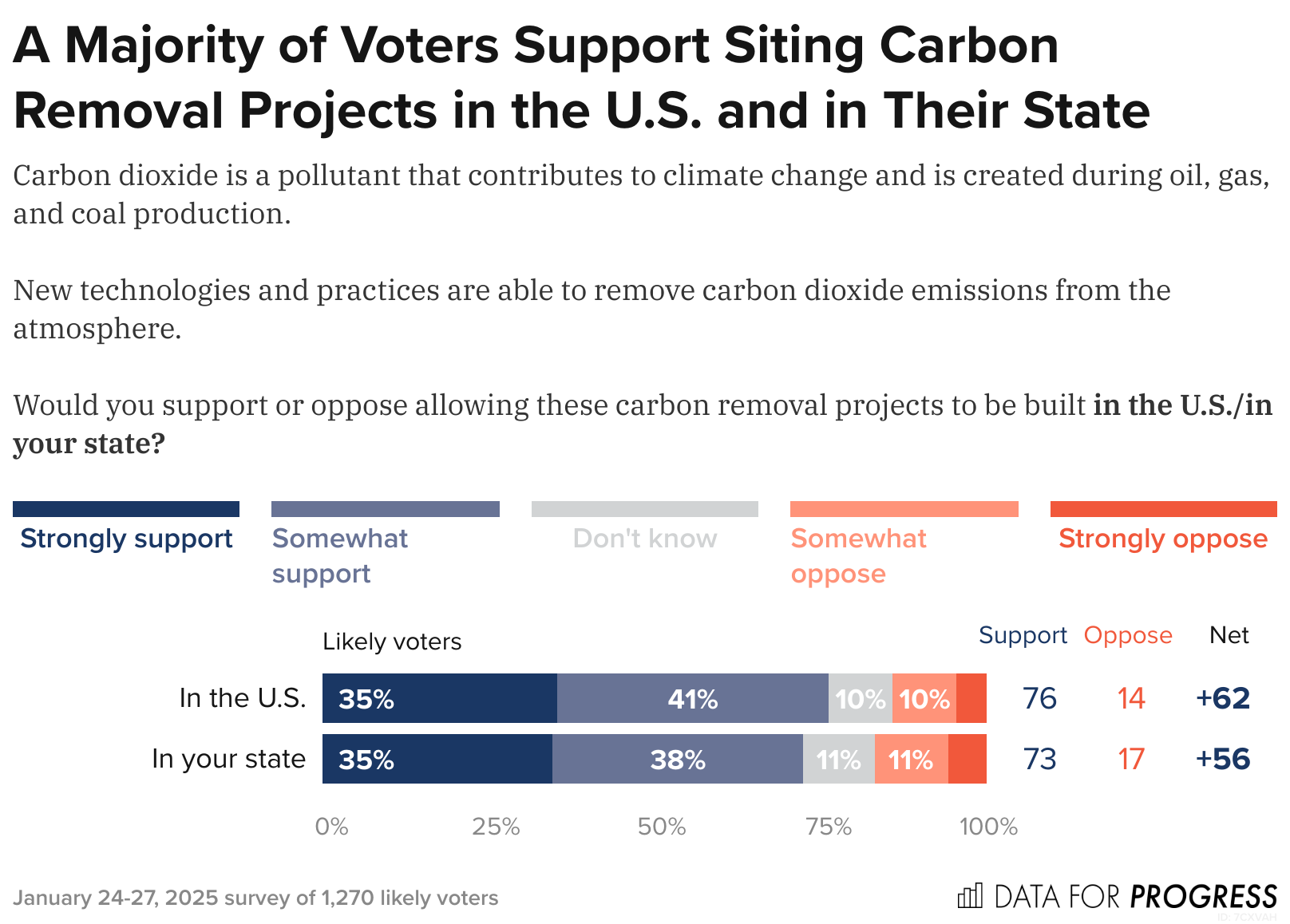
Voters were next asked whether they support new carbon removal projects being built in the U.S. and in their state, with 76% saying they support carbon removal projects being built in the U.S. and 73% saying they support them being built in their state.
When asked whether they think carbon removal would have a positive or negative impact on the country, a strong majority of voters (71%) think carbon removal would have a positive impact.
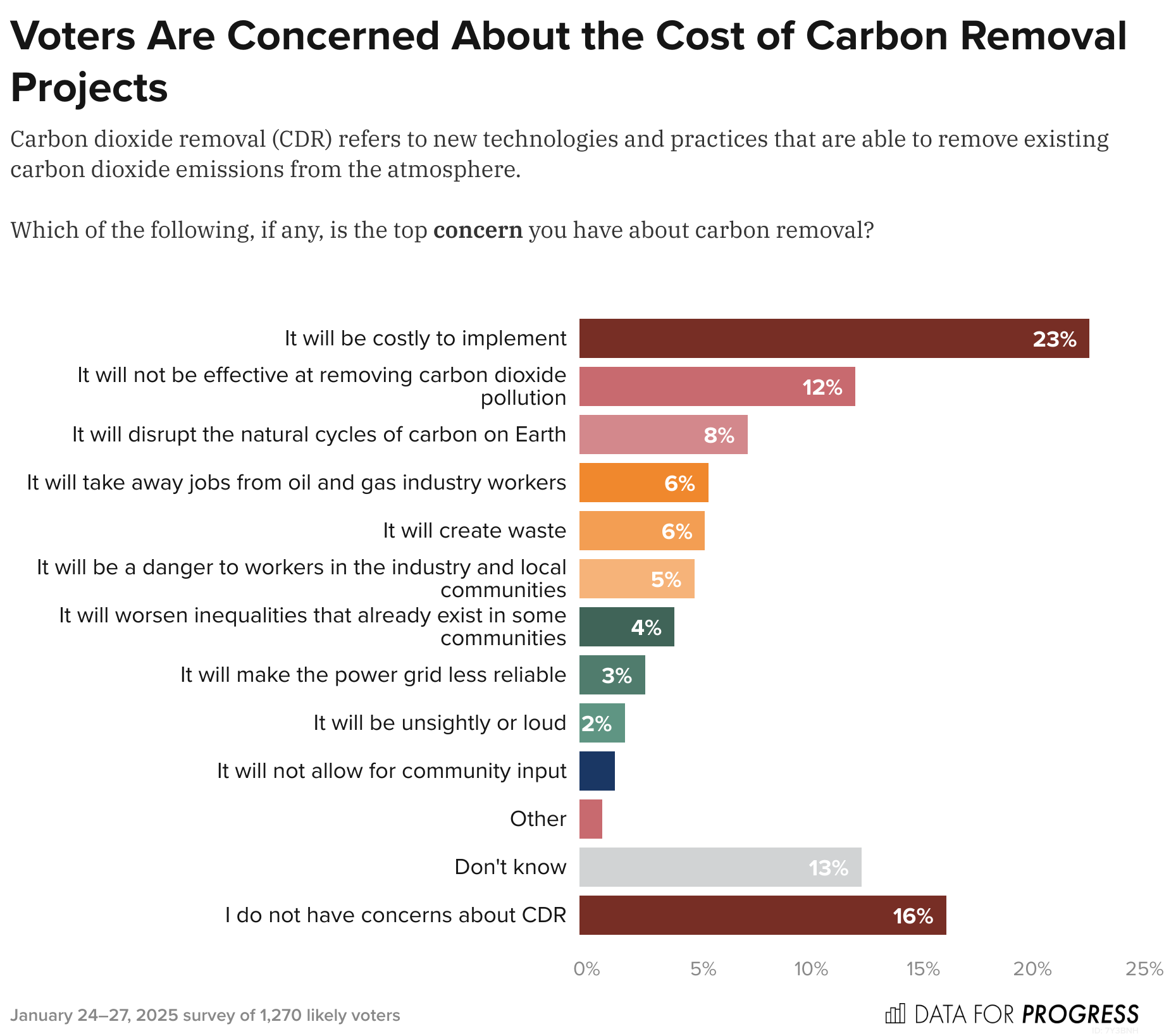
Voters say their top concerns about carbon removal are that it will be costly to implement (23%) and that it will not be effective at removing carbon dioxide (12%).
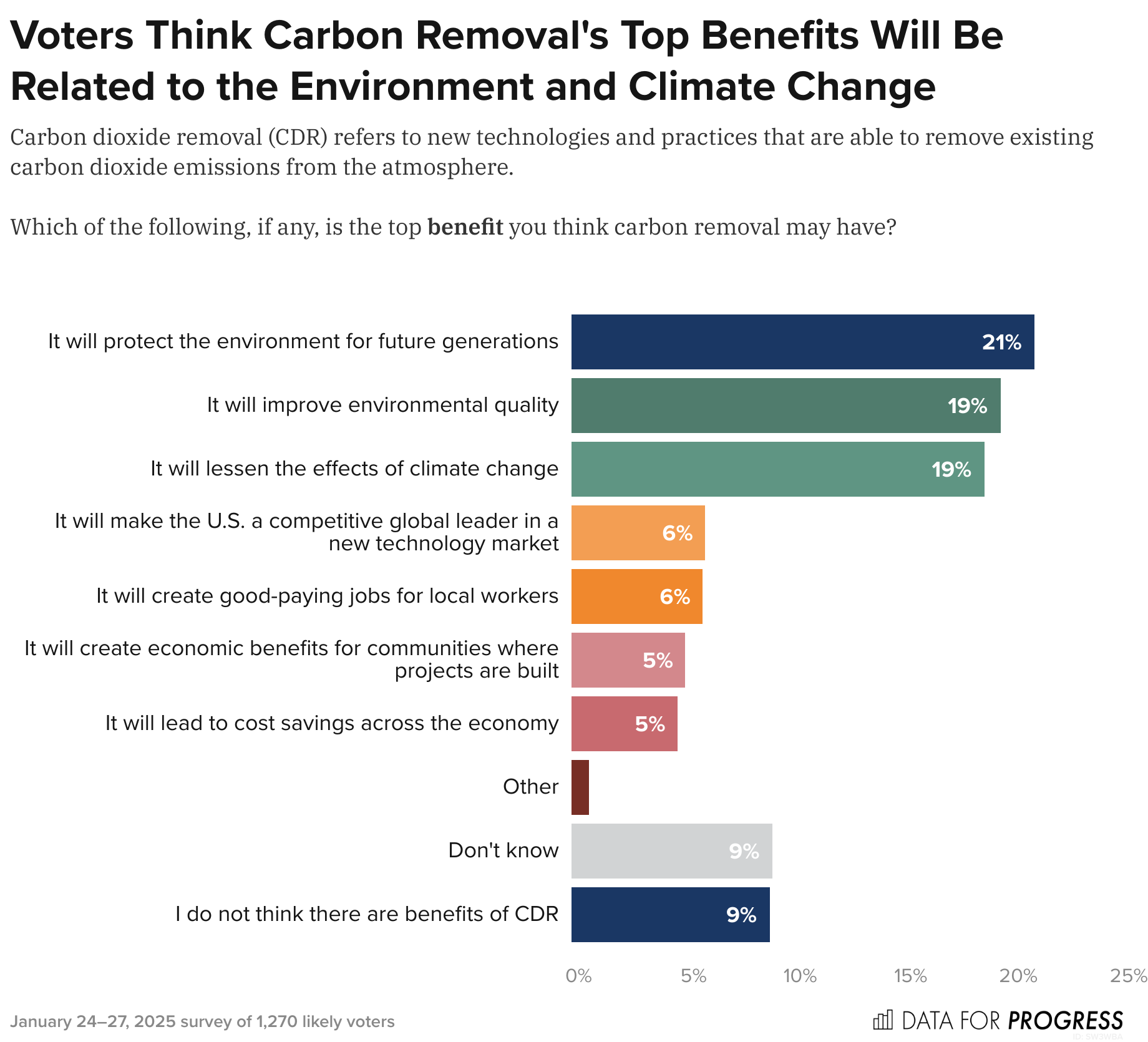
When asked about what benefits they think carbon removal may have, voters most often cite protecting the environment for future generations (21%), improving environmental quality (19%), and lessening the effects of climate change (19%).
Next, voters were provided with a list of potential community engagement activities and asked about how communities should be involved in the construction of new carbon removal projects. Strong majorities of voters say the following activities should take place:
- Project developers should consult with communities to determine where to place projects (74%);
- Project developers should conduct community engagement workshops in the communities where they place projects (73%);
- Project developers should guarantee benefits, like local jobs or pollution reduction, to communities that host carbon removal projects (71%);
- Project developers should guarantee community members have the right to approve project decisions (66%); and
- Project developers should give communities where they propose projects final say over whether or not a project should move forward (65%).

In November, Senators Michael Bennet and Lisa Murkowski introduced the Carbon Dioxide Removal Investment Act. The bill would establish a new production tax credit for CDR in the U.S. in an effort to boost a variety of CDR technologies at varying stages of development and deployment.
After reading a description of the bill, a bipartisan majority (68%) of voters say they support the Carbon Dioxide Removal Investment Act. This includes 77% of Democrats, 68% of Independents, and 60% of Republicans.
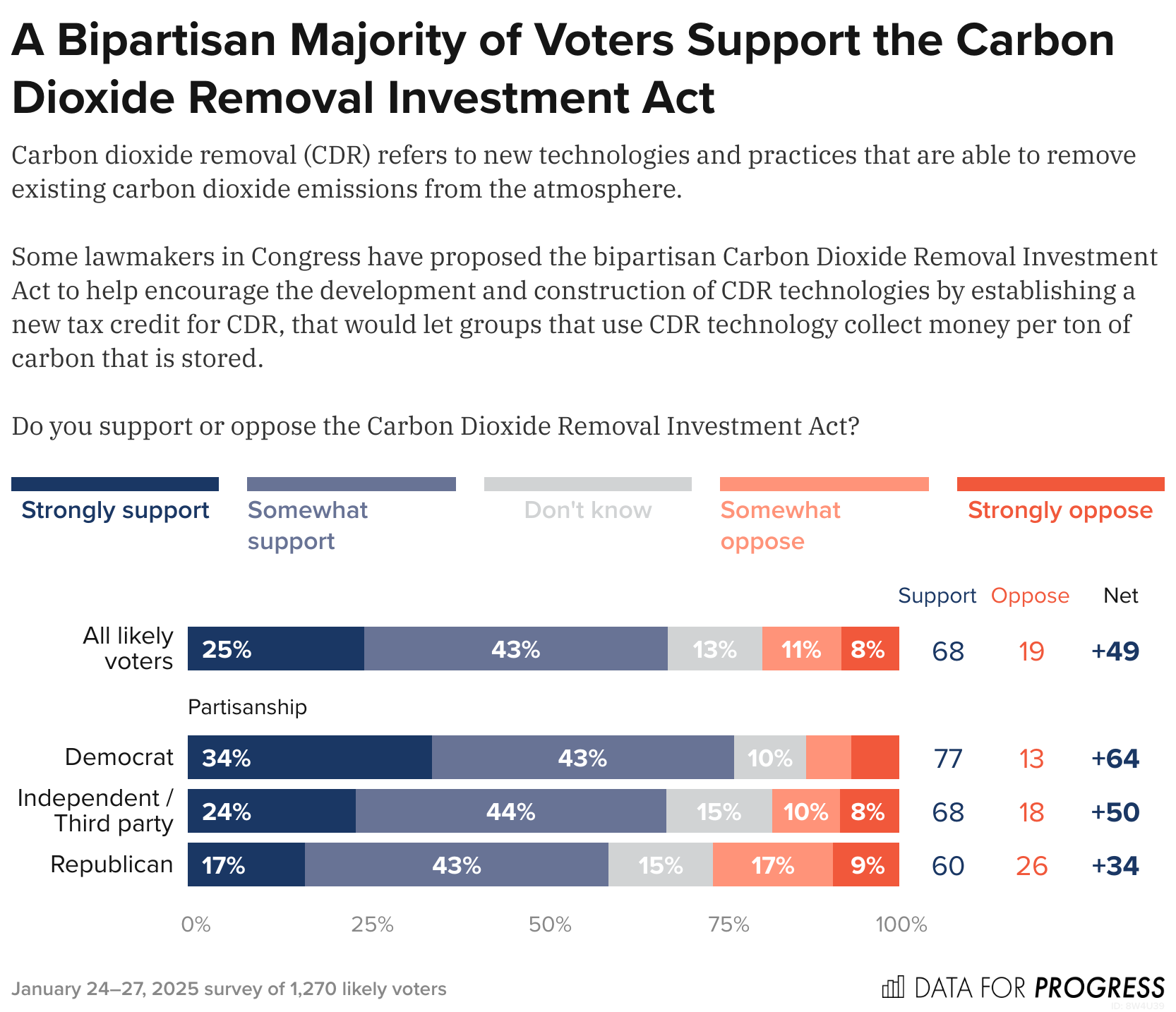
These results demonstrate broad public support for investing in carbon removal technologies and engaging communities in their development and deployment.
Catherine Fraser (@cathwfraser.bsky.social) is the Senior Climate and Energy Program Associate at Data for Progress.
Grace Adcox (@GraceAdcox) is the Senior Climate Strategist at Data for Progress.
Survey Methodology
From January 24 to 27, 2025, Data for Progress conducted a survey of 1,270 U.S. likely voters nationally using web panel respondents. The sample was weighted to be representative of likely voters by age, gender, education, race, geography, and recalled presidential vote. The survey was conducted in English. The margin of error associated with the sample size is ±3 percentage points. Results for subgroups of the sample are subject to increased margins of error. Partisanship reflected in tabulations is based on self-identified party affiliation, not partisan registration. For more information please visit dataforprogress.org/our-methodology.